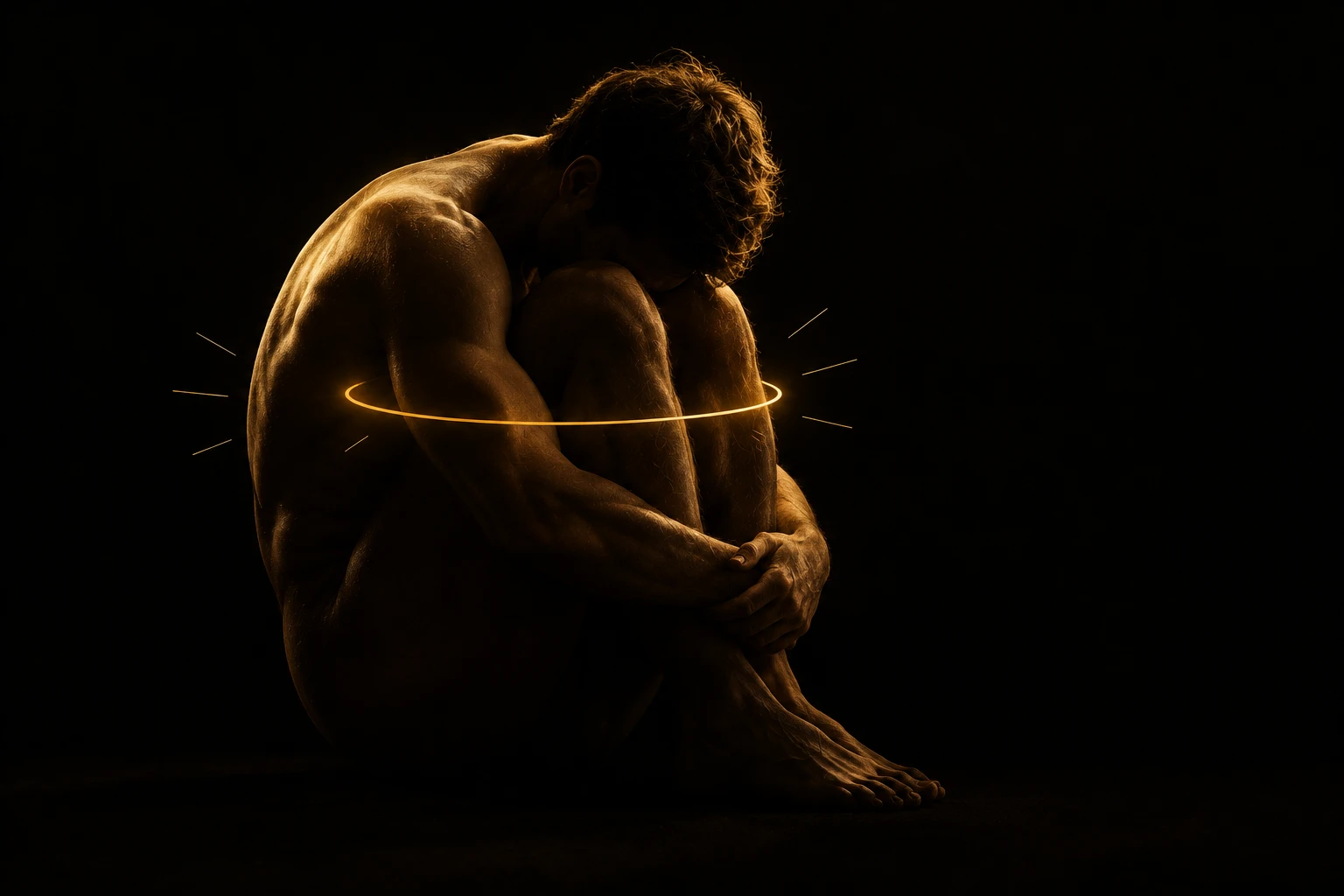
They discharged you weeks ago. The doctor said the tissue has healed, the physiotherapist told you that you can go back to your normal life, even the imaging tests — if you had any — come back clean. And yet, you still don't bend down like you used to, you still avoid that position, you still carry the bag with your other arm «just in case».
Nobody has told you as clearly as they should: your body may no longer have any reason to hurt, but your brain doesn't believe it yet.
This has a name, and it's one of the factors that most holds back a full recovery, even though it's almost never talked about outside the clinic: kinesiophobia, or fear of movement.
When pain leaves a mark on the mind
In our first article we explained the biopsychosocial approach: that pain isn't just a physical signal, but the interpretation your brain makes of biology, psychology, and environment together. And in the second, that this pain works like an alarm system that sometimes becomes miscalibrated.
Well, one of the most powerful ways psychology shapes that alarm is through protective learning. When something has really hurt you — with real intensity —, your brain does exactly what it's designed to do: memorize that movement, position, or activity as potentially dangerous, to prevent it from happening again.
In the short term, this is a completely healthy and adaptive response. The problem starts when that association between movement and danger stays imprinted long after the original reason has disappeared.
How the fear is born: from a one-off scare to kinesiophobia
The term «kinesiophobia» was coined by researchers Kori, Miller, and Todd in 1990 to describe something very specific: an excessive, irrational, and debilitating fear of movement or physical activity, driven by a feeling of vulnerability to (re)injury.[1]
The key word there is «excessive». We're not talking about the normal caution anyone has after a real injury — that's necessary and protective —, but about a fear that persists, generalizes, and ends up limiting a person's life far more than their actual physical condition would justify.
This is what's known as the fear-avoidance model, originally described by Lethem and his team in 1983[2] and later developed in depth by Vlaeyen and Linton.[3] The model explains that, after an injury, there are two possible paths.
If you interpret pain realistically — as something unpleasant but not catastrophic —, you tend to stay active, your body recovers normally, and the pain gradually eases over time. This is the path of coping.
But if you interpret that same pain catastrophically — «I'm doing more damage», «there's no fixing this», «if I move, it gets worse» —, fear appears. And that fear almost automatically leads to avoidance: you stop moving that area, you protect it, you watch it constantly. This is the path of avoidance.
The cycle that keeps you still
The problem with avoidance is that, in the short term, it works: if I don't move my shoulder, it doesn't hurt. That immediate relief reinforces the behavior, and the brain learns that avoiding is the right strategy. But in the medium term, the price is high.
- Physical deconditioning. A muscle that isn't used loses strength, a joint that doesn't move loses range, and the cardiovascular system loses capacity. That body, now weaker, is objectively more vulnerable — which feeds the original fear even more.
- Hypervigilance. You start paying disproportionate attention to any sensation in the area, which means you detect — and over-interpret — signals you wouldn't even have noticed before.
- Altered movement patterns. To «protect» the area, you start moving differently — compensating with other joints, tensing muscles that shouldn't be involved —, which often creates new discomfort elsewhere, that wrongly confirms there was reason to be afraid.
One of the hardest cycles to break.
This is how the cycle closes: fear → avoidance → deconditioning and hypervigilance → more sensitivity and more limitation → more fear. The longer it's been active, the harder it is to break, precisely because every turn of the cycle reinforces it.
Not all fears are the same
Something that's almost never explained is that kinesiophobia doesn't look the same in every patient. In clinic, the same name hides fears with very different origins and shapes depending on who's experiencing them.
- The post-surgical or recently injured patient. Here the fear tends to be very specific and localized: «if I push it, whatever was operated on or is healing will break». It's an understandable fear during the initial phase, but one that sometimes stays anchored long after the tissue has consolidated and the professional has given the go-ahead to progress.
- The athlete returning to competition. Here the fear isn't so much of the pain itself, but of re-injury at the moment of maximum demand — the explosive movement, the change of direction, the contact. The evidence on ACL tears is compelling: fear of re-injury is, today, the number one reason a physically recovered athlete doesn't return to competing at the same level, even above objective physical limitations.[4]
- The patient with chronic pain or a sensitized system. Here the fear tends to generalize: it's not one joint or movement, it's «effort» in general. It usually goes hand in hand with pain catastrophizing — the tendency to anticipate the worst possible outcome —, a psychological factor that's measured clinically and independently predicts how long disability will last.[5]
- The older adult. Here a close cousin of kinesiophobia shows up: fear of falling. It shares the same mechanism — avoidance that generates weakness, which generates more real risk, which reinforces the fear —, but with an added nuance: in this group, the fear tends to be more objectively justified, which means the approach needs to be even more careful and gradual.
Recognizing which of these profiles you see yourself in — or whether it's a mix of several — is the first step to addressing the fear the right way, because you don't work with the fear of a twenty-year-old athlete the same way you work with that of a seventy-year-old afraid of falling in the shower.
How it's measured and how the cycle is broken
In clinic, one of the most widely used questionnaires to assess fear of movement is the Tampa Scale of Kinesiophobia (TSK), which helps quantify how much fear is influencing the picture, beyond what the physical exam shows.[6]
But measuring it is only the first step. The treatment with the strongest scientific backing for breaking this cycle is called graded exposure: instead of avoiding the feared movement — or diving into it with no control at all, which usually makes the fear worse —, a hierarchy of situations is built, from least to most feared, and tackled one by one, progressively and under supervision, checking at each step that the body is responding well.
It's an approach related to the exposure therapy used in psychology to treat phobias, adapted to movement: it's not about «toughing out the pain» or «having willpower», but about giving the nervous system repeated evidence that a specific movement is safe, over and over, until the brain updates its prediction.
The other pillar, often combined with the one above, is pain neuroscience education, which we already mentioned in our second article: understanding why something hurts, on its own, reduces a significant part of the fear.
What this means for your recovery
If you've recognized yourself in something you just read, here's the good news: fear of movement isn't a personality trait or a character flaw. It's a learned response — and anything that's learned can be relearned.
Your body can be completely healed and still feel fragile — that feeling isn't lying about the past, but it doesn't have to decide your future either.
With this, the circle closes on NEXUS's first three articles: pain as an alarm system, the biopsychosocial approach to understanding it as a whole, and fear as one of the factors that keeps it active the longest. If you're missing one, we recommend reading what is pain? → and the biopsychosocial approach → to get the full picture.
Frequently asked questions
Is kinesiophobia the same as having common sense and being careful?
No. Reasonable caution after an injury is protective and temporary. Kinesiophobia is a disproportionate fear that persists long after the tissue has healed, and that ends up limiting a person's life more than the injury itself.
Isn't prolonged rest the safest option after an injury?
Only in the initial acute phase, and for a short time. Past that point, prolonged rest causes deconditioning — loss of strength, range, and capacity — which paradoxically increases risk and feeds the fear, instead of protecting you.
How do I know if I have a fear of movement without realizing it?
Some common signs: you avoid certain postures or movements «just in case» even when they don't hurt at that moment, you constantly watch that part of your body, or you feel immediate relief from avoiding an activity followed by more anxiety at the thought of having to do it.
Does graded exposure hurt?
It can cause some mild, controlled discomfort at certain points, but the goal is never to «tough out the pain». You progress at a pace your body can tolerate, checking at each step that the response is as expected before continuing.
How long does it take to overcome fear of movement?
It depends on how long it's been established and on the person's profile, but many patients start noticing changes in confidence within a few weeks of progressive work, though fully rebuilding confidence usually requires a sustained approach over several months.
Does this only happen to people with chronic pain?
No. It also shows up in recent acute injuries, in athletes returning to competition, and even in older adults as a fear of falling — each profile with a different origin and approach.
Can I work on this on my own, or do I need professional help?
You can start by understanding the mechanism, which is already an important step. But designing a safe exposure hierarchy tailored to your specific case is where a professional makes the difference, especially if the fear has been established for a while.
Does this replace a professional assessment of my kinesiophobia?
No. This article explains the mechanism behind kinesiophobia for educational purposes, but it doesn't replace an individualized assessment. Designing a safe, gradual exposure plan tailored to your case requires guidance from a physiotherapist or another registered healthcare professional.
Has fear been holding you back longer than the injury itself?
If you recognize yourself in this article, the work doesn't start by forcing the movement or by continuing to avoid it — it starts by understanding what kind of fear you have and designing, together, the way back, step by step.
Our contactReferences
- [1]Kori SH, Miller RP, Todd DD. Kinesiophobia: a new view of chronic pain behavior. Pain Management. 1990;3:35-43.
- [2]Lethem J, Slade PD, Troup JDG, Bentley G. Outline of a Fear-Avoidance Model of exaggerated pain perception—I. Behaviour Research and Therapy. 1983;21(4):401-408.
- [3]Vlaeyen JWS, Linton SJ. Fear-avoidance model of chronic musculoskeletal pain: 12 years on. Pain. 2012;153(6):1144-1147.
- [4]Sheean AJ, Lubowitz JH, Brand JC, Rossi MJ. Psychological Readiness to Return to Sport: Fear of Reinjury Is the Leading Reason for Failure to Return to Competitive Sport and Is Modifiable. Arthroscopy. 2023;39(8):1775-1778.
- [5]Sullivan MJL, Bishop SR, Pivik J. The Pain Catastrophizing Scale: development and validation. Psychological Assessment. 1995;7(4):524-532.
- [6]Dupuis F, Cherif A, Batcho CS, Massé-Alarie H, Roy JS. The Tampa Scale of Kinesiophobia: A Systematic Review of Its Psychometric Properties in People With Musculoskeletal Pain. Clinical Journal of Pain. 2023;39(5):236-247.
Did you like this article?