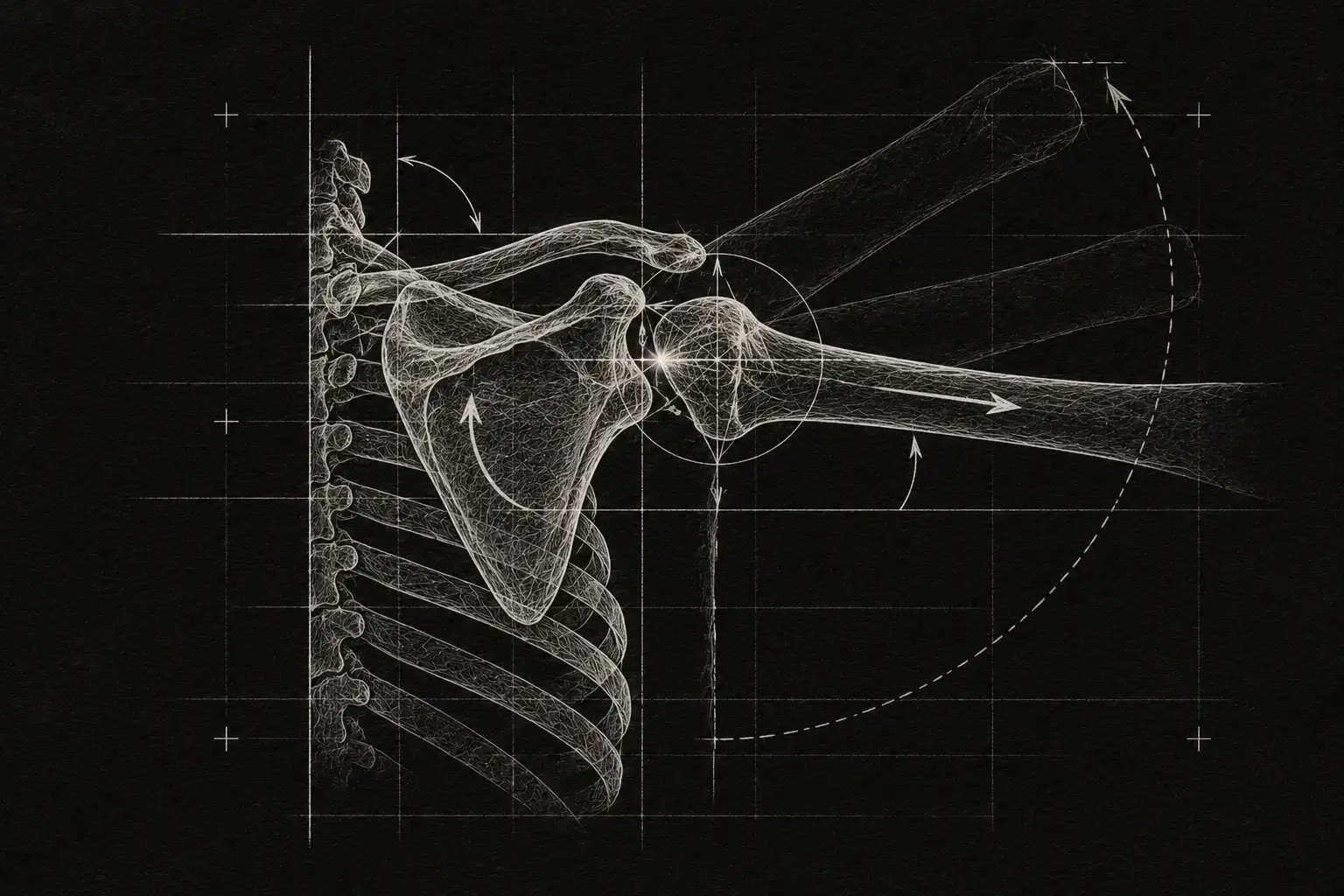
Your shoulder hurts when you comb your hair, put on a jacket or sleep on your side, and someone has told you “it’s the rotator cuff”, “it’s the biceps” or “it’s an impingement”. The shoulder is one of the most complex joints in the body, which is why it is so easy to get wrong. This guide explains how it is built, why it is so hard to assess and what the most common problems are, so you understand what is going on and know what to ask.
- A pain in the chest that spreads to the arm, neck or jaw.[5]
- A hot, red, swollen shoulder, or fever or feeling unwell together with the pain.[6]
- Pain that is sudden or very severe, or not being able to move the arm.[6]
- A blow or a fall followed by pain, a change in the shape of the shoulder or being unable to lift the arm.[6]
- Pins and needles or numbness that does not go away, or severe pain in both shoulders.[6]
- Pain that gets worse or has not improved after two weeks.[6]
What shoulder pain is and how many people it affects
“Shoulder pain” is not a diagnosis: it is a symptom with many possible causes. It covers everything from an overloaded tendon to a stiff joint or pain that comes from the neck. That is why this guide talks about kinds of problems and not a single disease.
It is one of the most common reasons to seek care for musculoskeletal pain, but the numbers change a lot depending on how it is defined and who is asked.[7]
See more
It is more common in women and in high-income countries.[2] In the UK, the incidence of people who seek care peaks at around age 50 and the overall frequency rises with age.[8] In the Netherlands, the highest incidence is among women and between ages 45 and 64.[9]
Many people have it, few seek care
The large ring is the people with shoulder pain and the small one, those who see a doctor in primary care. The pale band is the range between the lowest and the highest study. Change the number of people to see the proportion and tap each ring to see what it means.
In the general population
A median of 16% of people have shoulder pain, but the range is huge (0.7 to 55%): each study defines shoulder pain its own way, with more or less duration, with or without restricted movement, and asks about today, the past year or a whole lifetime.[2]
Those who see a doctor
In primary care the median drops to 2.4% (1.0 to 4.8%).[2] Almost half of those who seek care do so only once, and 13.6% were still seeking care three years later.[8]
The figures cannot be compared directly between studies: the definition, the country and the time frame change. They are orders of magnitude, not exact numbers.
The gap between the two figures indicates that most people with shoulder pain do not seek care. These studies do not measure why: what we do see is that very few get a complete assessment of their shoulder.
Inside the shoulder: a joint held from every side
Tap each layer (or the figure itself) to see what it is, what happens to it when it hurts… and above all, what it doesn’t mean.
Bones and joints: three bones, four joints
What it is. Three bones: the collarbone (clavicle), the shoulder blade (scapula) and the upper-arm bone (humerus). They meet in four joints: the glenohumeral, which is the main one (the round head of the humerus resting on a small socket of the scapula), the acromioclavicular, the sternoclavicular and the scapulothoracic, where the scapula slides over the ribs.[10]
When it hurts. After a blow or a fall, any of the bones can break or the joint can come out of place. Without a blow, shoulder pain rarely comes from the bone itself.
Careful. It doesn’t mean a joint this mobile is “fragile”: the head of the humerus is big and the socket is small, and that difference is exactly what allows all the movement… and what forces the muscles to hold it.
Capsule, labrum and ligaments: the reinforcement
What it is. A capsule surrounds the glenohumeral joint and ligaments reinforce it; the labrum is a ring of tissue that makes the socket a little deeper.
When it hurts. They can be damaged by a blow or a dislocation, or become stiff and painful, as in frozen shoulder, which will have its own article.
Careful. It doesn’t mean they are what holds the shoulder most: given its mobility, stability depends mainly on active muscle control, and the capsule, labrum and ligaments play a smaller role.[1]
Rotator cuff: the fine control
What it is. Four small muscles (supraspinatus, infraspinatus, teres minor and subscapularis) whose tendons wrap around the head of the humerus like a cuff and keep it centred. Between them and the acromion bone there is a small sac, the bursa, that eases the gliding.
When it hurts. It is the area most linked to shoulder pain: the tendon, the bursa and tears can hurt, alone or together. They are now grouped under the name rotator cuff-related shoulder pain.[11]
Careful. It doesn’t mean every cuff finding is the cause of the pain: cuff abnormalities are also very common in people without symptoms.[4]
Large muscles and scapula: the power and the base
What it is. The deltoid, the pectoral, the trapezius and other large muscles give power and move the arm; those around the scapula position it so the arm has a base that moves with it. The long tendon of the biceps runs through the joint at the front.
When it hurts. They can hurt through overload or from holding postures for a long time, and when one group works differently from the rest, the way the scapula moves changes.
Careful. It doesn’t mean a muscle that feels hard or knotted is always the source of the pain, nor that a “bad” posture explains it: we look at that below.
Nerves and neck: where the wiring comes from
What it is. The nerves of the shoulder and the arm leave from the spine of the neck. That is why some shoulder pain begins in the neck, or changes when the neck moves.
When it hurts. In a study of 60 people with shoulder pain, in half of them the pain changed by at least 30% when the neck was examined.[12]
Careful. It doesn’t mean “it all comes from the neck”: it means the neck must always be checked, and that is not always done.[13]
What your scan does (and doesn’t) say
Those same structures are the ones that appear in an imaging report. If you’ve had an X-ray or an MRI of the shoulder, the report may mention “tendinosis”, “partial tear” or “acromioclavicular osteoarthritis”: it sounds serious. See how common these findings are.
| Imaging finding | In the studies |
|---|---|
| Cuff abnormalities (age 80 or over) | 62 % |
| Acromioclavicular osteoarthritis | 70 % |
Sources: a systematic review of 30 studies with 6112 shoulders (cuff abnormalities by age)[4] and a review of 10 studies with 1831 shoulders (acromioclavicular osteoarthritis).[14]
These findings increase with age and also appear in shoulders without pain, so an image on its own does not explain the pain. The authors of the first review consider that cuff degeneration is part of normal ageing, and that it is hard to know when an abnormality is new or the cause of the symptoms.[4]
For the acromioclavicular joint, the authors conclude that a diagnosis of symptomatic osteoarthritis should be made sparingly, because almost everyone has changes.[14]
If the image alone does not explain the pain, we have to look at how the pieces move and work together, starting with the shoulder blade and the shoulder.
A shoulder held from every side: what happens when one pulls harder
Shoulder stability depends mostly on active muscle control, and the capsule and ligaments play a smaller role.[1] It is like a tent held by ropes from every side: if one pulls harder than the others, the pole shifts. See how the shoulder blade and the shoulder work together when you raise your arm.
How the shoulder blade and the shoulder move together
Seen from behind, with the arm rising to the side (abduction). It is not only the humerus that moves: the shoulder blade also turns on the ribs, but not from the first degree. Move the control and see when each one comes in. The dashed line is the shoulder blade at rest.
The first 30°.
The shoulder blade moves little, and differently in each person, and acts as a base (the “setting phase” described by Inman): almost all the movement comes from the shoulder joint, the humerus inside its socket.[15]
From 30° on.
The shoulder blade comes in and starts turning upwards, and the clavicle rises with it, while the humerus keeps rising. They go together: the shoulder joint adds a little more than a degree and a half for each degree the shoulder blade turns.
With the arm up (180°).
Physiotherapy textbooks give about 120° at the shoulder joint and about 60° at the shoulder blade, a 2 to 1 ratio in Inman’s classic description.[15] Measured directly in eight people it was 1.7 to 1, with about 50° of shoulder blade turning.[16] If the shoulder blade does not follow, the humerus has to do more on its own.
Diagram with the average proportions of the adult body. The textbook figures are approximate and each person moves in their own way.
Careful with what the evidence says. That this image is so well known does not mean posture is the cause of the pain: a systematic review found moderate-level evidence that the curvature of the upper back does not differ between people with and without shoulder pain.[17] What seems more important is how the scapula moves: altered scapular movement is present in many shoulder injuries, although its exact role is not clear,[18] and in athletes without pain it was linked to a 43% higher risk of having pain later (35% versus 25%).[19]
That is why we talk more about movement and balance between muscles than about a “correct posture”: what matters is that the shoulder has a base that moves well and muscles that hold it. And when something in all this fails, the pain is not always felt where the problem is.
Pain misleads: where it hurts is not where it comes from
The same spot on the shoulder can hurt because of things that have nothing to do with what lies right underneath: muscles, tendons, joints, nerves from the neck or even organs of the chest and abdomen. Tap a zone of the body and you will see everything that can send pain there.
On top (shoulder and trapezius)
The top of the shoulder is easily confused with the neck. The trapezius is the muscle most often named here, but it is not the only one that can hurt there.
Muscles
- Upper trapezius Pain on the side of the neck, behind the ear and at the temple.
- Lower trapezius Pain in the upper back and neck, towards the tip of the shoulder and above the shoulder blade.
- Levator scapulae Pain between the neck and the top of the shoulder blade, with some pain along the inner edge of the shoulder blade and behind the shoulder.
Tendons and joints
- The acromioclavicular joint It shows osteoarthritic changes in 70% of MRI scans of shoulders without pain,[14] so seeing them on an image is not enough to blame it.
- The joint between the clavicle and the sternum Its pain is felt in the upper chest and can reach the shoulder.
Nerves
- The C3–C5 neck roots They supply the skin over the top of the shoulder: neck pain is felt there.
- The phrenic nerve (C3–C5) It leaves the same roots and runs to the diaphragm: when the diaphragm is irritated, the pain shows up at the tip of the shoulder.
Spine and organs
- The joints and discs of the neck (C4–C5) Their pain is felt in the neck and runs down the trapezius to the shoulder.
- Liver, gallbladder, spleen or lung They irritate the diaphragm and can cause pain at the tip of the shoulder without anything wrong in the shoulder.
Front of the shoulder
Many different things are felt at the front. That it hurts right where the biceps is does not mean the biceps is to blame: several structures share the area and the neck can also send pain here.[12]
Muscles
- Infraspinatus Pain in the front and middle of the deltoid, which can spread along the front of the arm and reach the wrist and hand.
- Anterior deltoid Pain over the front of the shoulder.
- Pectoralis major Pain in the chest and at the front of the shoulder.
- Pectoralis minor Pain in the chest and at the front of the shoulder; it can run down the inner edge of the arm towards the fingers.
- Biceps brachii Pain in the muscle itself and in the area of the anterior deltoid, and sometimes above the shoulder blade.
- Coracobrachialis Pain at the front of the shoulder that can run down the back of the arm.
Tendons and joints
- The long tendon of the biceps It runs in front of the head of the humerus.
- The rotator cuff (supraspinatus and subscapularis) Their tendons lie just underneath.
- The joint capsule It can hurt at the front and side when it is irritated or stiff.
- The acromioclavicular joint It is at the end of the clavicle, very close.
Nerves
- The C5–C6 neck roots They can send pain to the front of the shoulder.[12]
Spine and organs
- The heart Pain at the front of the shoulder with chest pressure, breathlessness or a cold sweat: it needs urgent medical attention.[5]
Side of the shoulder (deltoid)
Pain on the side of the shoulder, over the deltoid, is very common in what is now called rotator cuff-related shoulder pain,[11] but it can also come from the neck.
Muscles
- Supraspinatus Pain on the side of the shoulder that can spread down the arm to the elbow.
- Middle deltoid Pain over the side of the shoulder.
- Infraspinatus Pain in the front and middle of the deltoid, which can spread along the front of the arm and reach the wrist and hand.
Tendons and joints
- The rotator cuff and the bursa Pain on the side of the shoulder is the typical pain of rotator cuff-related pain.[11]
- The joint capsule When it is stiff, the pain is felt at the side and runs down the arm.
Nerves
- The C5 nerve root (neck) It can cause pain on the side of the shoulder and arm.
- The axillary nerve It supplies the skin on the side of the shoulder; if it is damaged, which is uncommon, numbness appears there and so does weakness when raising the arm.
Arm (outer side)
Pain that runs down the arm does not always start in the shoulder: the nerves of the neck and several muscles can send it there.
Muscles
- Supraspinatus Pain on the side of the shoulder that can spread down the arm to the elbow.
- Infraspinatus Pain in the front and middle of the deltoid, which can spread along the front of the arm and reach the wrist and hand.
- Scalenes Pain in the chest, along the inner edge of the shoulder blade, in the shoulder and down the back and side of the arm to the thumb and index finger.
- Triceps (long head) Pain behind the shoulder and at the back of the arm.
Tendons and joints
- The capsule and the cuff When they are irritated, the pain runs down the arm to the level of the elbow.
Nerves
- The C5–C6 neck roots An irritated root can cause pain that runs down the side of the arm.
- The brachial plexus (between the neck and the shoulder) If it is compressed at the thoracic outlet, pain and tingling run down the arm.
Spine and organs
- The heart Pain running down the left arm with chest pressure needs urgent medical attention.[5]
Behind the shoulder
Pain behind the shoulder means looking at the neck and the upper back, and not only at the shoulder.
Muscles
- Subscapularis Pain behind the shoulder and down the back of the arm, which can reach the wrist.
- Teres minor Deep pain in the shoulder, mostly behind.
- Teres major Pain behind the shoulder and at the back of the arm.
- Posterior deltoid Pain over the back of the shoulder.
- Latissimus dorsi Pain at the lower tip of the shoulder blade and behind the shoulder.
- Triceps (long head) Pain behind the shoulder and at the back of the arm.
Tendons and joints
- The back of the rotator cuff The tendons of infraspinatus and teres minor.
- The back of the capsule and the labrum They can hurt at the back when the shoulder becomes unstable or irritated.
Nerves
- The suprascapular nerve If it is trapped in a notch of the shoulder blade, it is an uncommon cause of pain behind the shoulder, and it usually comes with weakness of infraspinatus.
- The C6–C7 neck roots They can send pain to the back of the shoulder.
Spine and organs
- The upper back and the ribs (T2–T6) Their joints can hurt behind the shoulder.
Shoulder blade (between the blade and the spine)
Pain between the shoulder blade and the spine almost never comes from the shoulder: it is mostly shared between back muscles, the neck and the ribs.
Muscles
- Rhomboids Superficial pain along the inner edge of the shoulder blade.
- Levator scapulae Pain between the neck and the top of the shoulder blade, with some pain along the inner edge of the shoulder blade and behind the shoulder.
- Infraspinatus Pain in the front and middle of the deltoid, which can spread along the front of the arm and reach the wrist and hand.
- Scalenes Pain in the chest, along the inner edge of the shoulder blade, in the shoulder and down the back and side of the arm to the thumb and index finger.
- Serratus posterior superior Deep pain under the upper part of the shoulder blade.
- Latissimus dorsi Pain at the lower tip of the shoulder blade and behind the shoulder.
Tendons and joints
- The shoulder blade on the ribs When it does not move well, it can hurt and make noise when moved.
- The joints of the ribs with the spine (T2–T6) They hurt between the spine and the shoulder blade, especially when breathing deeply or turning.
Nerves
- The C6–C8 neck roots They can cause pain between the spine and the shoulder blade.
- The dorsal scapular nerve It is a nerve that only moves muscles (the rhomboids): if it is trapped, it can cause pain between the spine and the shoulder blade, although it is hard to recognise.
Spine and organs
- The joints and discs of the neck (C5–C7) Their pain is felt between the shoulder blades.
- Heart, gallbladder, lung or oesophagus They can cause pain between the shoulder blades; if it comes with chest pressure or breathlessness, it needs urgent medical attention.[5]
The trigger point pain patterns are those described in the Travell and Simons manual.[20] They help to know where to look, but they are not proof: a systematic review of nine studies found none that met all the quality criteria, and the reliability of the examination varied widely.[21] It is a guiding, qualitative map: there are no reliable figures for what share of each zone belongs to each structure. What we do know is that no single test settles it: the performance of the physical examination tests of the shoulder is limited (the Hawkins test for impingement has a sensitivity of 0.58 and a specificity of 0.67),[3] and an international consensus of physical therapists found no special test on which they all agreed.[22]
That is why a good assessment does not stop at the painful spot: it reviews the neck, the scapula, movement, strength and how the pain changes with load. In a review of 102 trials on subacromial pain, one in four did not carry out or report any screening of the neck.[13] With all this in mind, these are the most common shoulder problems.
The most common kinds of shoulder problem
There is no reliable split of how many cases belong to each problem: in practice very general labels are used (in the UK, five codes out of 426 possible ones accounted for 74.6% of new diagnoses).[8] This is what we do know about each one, and each will have its own article. Choose a group, or tap a card to see where it is felt and when it hurts.
Rotator cuff-related shoulder pain
It groups rotator cuff tendinopathy, subacromial pain (“impingement”) and tears that hurt. It is the most common group.[11]
Rotator cuff tendinitis was the most recorded diagnosis (29%) in Dutch primary care.[23]
Article coming soonSubacromial bursitis
Irritation of the sac between the cuff and the bone. It usually appears alongside cuff pain and is studied within that group.[24]
Article coming soonFrozen shoulder
Excess scar tissue across the glenohumeral joint that causes pain and stiffness; it can appear without a reason or after surgery or trauma.[25]
Article coming soonInstability and dislocation
The head of the humerus comes out of place, or is about to. It is more common after trauma or in sport.
Article coming soonAcromioclavicular joint
Wear or injury of the joint at the top of the shoulder. The changes are almost universal with age, so seeing them is not enough.[14]
Osteoarthritis in 70% of MRI scans of shoulders without pain.[14]
Article coming soonGlenohumeral osteoarthritis
Wear of the main shoulder joint: pain and loss of movement.
Article coming soonCalcific tendinitis
A deposit of calcium inside a tendon, which can hurt a lot, suddenly.
Article coming soonLong head of the biceps
Pain at the front, where the tendon passes through the joint. Not all pain at the front is from the biceps (see above).
Article coming soonPain coming from the neck
The shoulder hurts, but the origin or part of the origin is in the cervical spine.[12]
Neck contribution in 30 of 60 people with shoulder pain (a small study).[12]
Article coming soonWhich of them you have is not decided by the painful spot or by a single test: it is decided by a complete assessment. And around all of them circulate ideas worth letting go of.
Shoulder pain myths: three ideas worth letting go of
Tap each card to turn it over and see what the evidence says.
“It hurts at the front: it must be the biceps.”
Pain at the front can be sent by several structures (the cuff, the acromioclavicular joint, the capsule, the biceps tendon) and also by the neck: in a study of 60 people with shoulder pain, the neck contributed to the pain in half of them.[12] And no single physical test confirms the diagnosis.[3]
“If the test is positive, I know what I have.”
Physical tests of the shoulder have limited performance: for subacromial impingement, the Neer test has a sensitivity of 72% and a specificity of 60%, Hawkins-Kennedy 79% and 59%, and the painful arc 53% and 76%.[26] With a specificity of 59%, four out of ten people without the problem would test positive.
“My shoulders are rounded forward: that’s why it hurts.”
It is a widespread idea, but a systematic review found moderate-level evidence that the curvature of the upper back does not differ between people with and without shoulder pain.[17] What seems more relevant is how the scapula moves, although its exact role is not clear.[18]
The full map: body, mind and surroundings
Persistent pain almost never has a single cause: body, mind and surroundings add up. That is why it is worth looking at all three at once.
What I see in clinic
In my practice, the shoulder almost never arrives as a question: it arrives as a conclusion.
“It hurts at the front, it must be the biceps.” “I was told I have impingement.” They bring the name of a structure and the conviction that the problem is right there, often with an MRI that says something “shows”.
What changes the way I look is taking a step back. I stop looking only at the spot that hurts and look at the whole: how the scapula moves, what is going on in the neck, what load that shoulder takes every day and what that person has stopped doing for fear of making it worse.
The same zone can hurt because of things that have nothing to do with each other. Understanding that changes how the pain is lived: it stops being a mystery and becomes something that can be put in order and worked on step by step.
For professionals and students
Show the technical contentAssessment pathway, test performance, diagnostic groups, referral criteria and official documents.
The evidence and clinical reasoning behind the article, in technical terms. Figures come from each source’s official abstract. Tap an underlined abbreviation to see its meaning.
Abbreviations
RCRSP rotator cuff-related shoulder pain · SLAP superior labrum anterior to posterior lesion · DOR diagnostic odds ratio · CI confidence interval
Clinical assessment of the painful shoulder
The essentials: first rule out what is not the shoulder, always screen the neck, and remember that no single test confirms the diagnosis.
Clinical pathway
- Rule outChest pain radiating to the arm, neck or jaw,[5] a hot shoulder with fever, trauma with deformity or inability to raise the arm, neurological deficit or very severe or sudden pain.[6]
- Screen the neckIn 60 people with shoulder pain, 50% (95% CI 37–63) had a cervical contribution; the pain changed by ≥ 30% after cervical screening.[12] In 102 trials of subacromial pain there was no standard method and in 26 no screening was carried out or reported.[13]
- ClassifyReproduction of symptoms with load and with overhead activities, and the need to assess active and resisted movement: the descriptors with the greatest consensus for RCRSP.[22]
- Cross-checkAdd information before concluding: a positive test changes the probability little, and imaging findings are common without symptoms.[3][4]
What the consensus says
- Descriptors
- A Delphi panel of 15 expert physical therapists agreed 18 clinical descriptors across six domains (10 subjective examination, 1 patient-reported outcome measure, 3 diagnostic examination, 2 physical examination and 2 functional tests).[22]
- Special tests
- None reached consensus within the special-tests domain.[22]
Muscle imbalance patterns described in the clinic
- Tight chest
- Described: forward shoulder, rounded upper back and anterior tilt of the scapula: pectoralis minor inserts on the coracoid process and, with a lot of tension, pulls the scapula forward and down.
- Tight upper neck and upper trapezius
- Described: raised shoulder and forward head: they hold the head and lift the shoulder.
- Deep neck muscles doing less
- Described: forward head: they help keep the head over the shoulders.
- Middle and lower back doing less
- Described: loss of stability of the scapula, forward shoulder and rounded upper back: rhomboids, middle and lower trapezius and serratus anterior keep the scapula on the ribs and make it turn well.
- Note
- It is the classic clinical pattern and has no direct source: static posture has not shown differences between people with and without shoulder pain.[17]
Performance of the physical tests
| Test | Used for | Sensitivity / specificity | Note |
|---|---|---|---|
| Neer | Subacromial impingement | 72% / 60%[26] | Positive in many people without the problem |
| Hawkins-Kennedy | Subacromial impingement | 79% / 59%[26] | Another meta-analysis: 58% / 67%, DOR 2.86[3] |
| Painful arc | Subacromial impingement | 53% / 76%[26] | More specific than sensitive |
| Supraspinatus test | Full-thickness tear | 74% / 77%, DOR 9.24[3] | The highest DOR in that review |
| Compression-rotation | SLAP lesion | 43% / 89%[3] | No single test stood out overall[3] |
Diagnostic groups and frequency data
The essentials: the rotator cuff group is the most common, but the exact split is not well measured because general labels are used in practice.
Frequency figures
Useful definitions
- RCRSP
- Umbrella term that includes subacromial pain (impingement), rotator cuff tendinopathy and symptomatic partial and full-thickness tears.[11]
- Subacromial-subdeltoid bursitis
- Among the secondary pathologies that may accompany impingement, together with tendinopathy or tears of the cuff or the biceps and labral damage.[24]
- Frozen shoulder
- Adhesive capsulitis: excessive scar tissue across the glenohumeral joint, with pain, stiffness and dysfunction; primary or secondary to surgery or trauma.[25]
When to refer
The essentials: what is not the shoulder and what cannot wait comes before any musculoskeletal assessment.
Chest pain that spreads to the arm, neck or jaw: urgent medical care, a possible cardiac cause.[5]
Urgent medical assessment: suspected joint infection.[6]
Urgent appointment: very severe or sudden pain, inability to move the arm, severe pain in both shoulders, swelling or change in shape, and pain after an injury or a fall.[6]
Medical assessment: may indicate neurological involvement.[6]
If the pain gets worse or has not improved after two weeks, or moving the arm is very difficult, a complete assessment is advisable.[6]
Official documents and key reviews
The essentials: the official patient information and the reviews on shoulder tests; each condition will have its guidelines in its own article.
When to get medical help, when urgently, and which symptoms justify it.[6]
Open the original documentnhs.ukReview of the diagnostic accuracy of physical tests for impingements and local lesions of the bursa, tendon or labrum.[24]
Open the original documentdoi.orgMasterclass on cuff function, symptoms, aetiology, assessment, management, imaging and uncertainties.[11]
Open the original documentdoi.orgKeep exploring
What if yours fits one of these cases? A few pointers, and each one’s guide is coming soon:
 PhysiotherapyAug 24, 2026 Every day you don’t move, your body thinks you’re dying Read more
 PhysiotherapyAug 16, 2026 What is pain? Your body’s alarm system Read more
Frequently asked questions about shoulder pain
Are “impingement” and rotator cuff pain the same thing?
Today they are grouped under rotator cuff-related shoulder pain, which includes what used to be called “impingement”.[11]
See more
Today they are grouped under the name rotator cuff-related shoulder pain, which includes subacromial pain (what used to be called “impingement”), rotator cuff tendinopathy and tears that hurt.[11] It is not an exact label: the tests used for impingement have limited performance and do not confirm the diagnosis on their own.[3]
What if the pain runs down the arm or my hand tingles?
It can have a neural origin: an irritated nerve, for example where it leaves the neck, causes pain that runs down the arm, sometimes with tingling. The neck contributes to many shoulder pains;[12] if the tingling or numbness persists, ask for a medical assessment.[6]
See more
Pain that runs down the arm does not always start in the shoulder, and it can have a neural origin. When a nerve is irritated or compressed, for example where it leaves the neck, the pain does not stay in one spot: it follows the path of that nerve, sometimes down to the hand, and is usually accompanied by tingling or numbness. That is why the neck should also be examined: in a series of 60 people with shoulder pain, half had a cervical contribution.[12] If the tingling or numbness does not go away, ask for a medical assessment, because it means a nerve may be involved.[6]
When should I see a doctor?
With radiating chest pain, emergency care;[5] with severe pain, fever or after a fall, an urgent appointment;[6] and if it hasn’t improved after two weeks, see a doctor.[6]
See more
With chest pain that spreads to the arm, neck or jaw, seek urgent medical help.[5] Ask for an urgent appointment if the pain is very severe or sudden, you cannot move the arm, there is fever, swelling or a change in shape, or after a fall; and see a doctor if it has not improved after two weeks.[6]
Does this guide replace an assessment?
No: every shoulder needs an in-person assessment.
See more
No. It is general information to understand the shoulder. Every shoulder needs an in-person assessment, because pain misleads and no single test confirms the diagnosis.[3]
Want us to look at it together?
Understanding what is going on in your shoulder is the first step. The next is a complete assessment that looks at the shoulder, the neck and how you move, to design a plan with you that fits your body, your work and your life.
Our contactReferences
Show the 26 references
- [1]Veeger HEJ, van der Helm FCT. Shoulder function: the perfect compromise between mobility and stability. J Biomech. 2007;40(10):2119-2129.Review↗
- [2]Lucas J, van Doorn P, Hegedus E, Lewis J, van der Windt D. A systematic review of the global prevalence and incidence of shoulder pain. BMC Musculoskelet Disord. 2022;23:1073.Systematic review↗
- [3]Gismervik SØ, Drogset JO, Granviken F, Rø M, Leivseth G. Physical examination tests of the shoulder: a systematic review and meta-analysis of diagnostic test performance. BMC Musculoskelet Disord. 2017;18:41.Meta-analysis↗
- [4]Teunis T, Lubberts B, Reilly BT, Ring D. A systematic review and pooled analysis of the prevalence of rotator cuff disease with increasing age. J Shoulder Elbow Surg. 2014;23(12):1913-1921.Meta-analysis↗
- [5]NHS. Heart attack. nhs.uk (page last reviewed 31 March 2026; consulted 9 November 2026).Official health source↗
- [6]NHS. Shoulder pain. nhs.uk (page last reviewed 22 May 2023; consulted 9 November 2026).Official health source↗
- [7]Luime JJ, Koes BW, Hendriksen IJ, Burdorf A, Verhagen AP, Miedema HS, et al. Prevalence and incidence of shoulder pain in the general population; a systematic review. Scand J Rheumatol. 2004;33(2):73-81.Systematic review↗
- [8]Linsell L, Dawson J, Zondervan K, Rose P, Randall T, Fitzpatrick R, et al. Prevalence and incidence of adults consulting for shoulder conditions in UK primary care; patterns of diagnosis and referral. Rheumatology (Oxford). 2006;45(2):215-221.Observational study↗
- [9]Greving K, Dorrestijn O, Winters JC, Groenhof F, van der Meer K, Stevens M, et al. Incidence, prevalence, and consultation rates of shoulder complaints in general practice. Scand J Rheumatol. 2012;41(2):150-155.Observational study↗
- [10]Terry GC, Chopp TM. Functional anatomy of the shoulder. J Athl Train. 2000;35(3):248-255.Review↗
- [11]Lewis J. Rotator cuff related shoulder pain: assessment, management and uncertainties. Man Ther. 2016;23:57-68.Review↗
- [12]Roldán-Ruiz A, Bailón-Cerezo J, Falla D, Torres-Lacomba M. The prevalence of cervical contribution in patients reporting shoulder pain. An observational study. Musculoskelet Sci Pract. 2024;73:103158.Observational study↗
- [13]Walker T, Salt E, Lynch G, Littlewood C. Screening of the cervical spine in subacromial shoulder pain: a systematic review. Shoulder Elbow. 2019;11(4):305-315.Systematic review↗
- [14]Rossano A, Manohar N, Veenendaal WJ, van den Bekerom MPJ, Ring D, Fatehi A. Prevalence of acromioclavicular joint osteoarthritis in people not seeking care: a systematic review. J Orthop. 2022;32:85-91.Systematic review↗
- [15]Inman VT, Saunders JB, Abbott LC. Observations of the function of the shoulder joint (reprint of the 1944 article). Clin Orthop Relat Res. 1996;(330):3-12.Observational study↗
- [16]McClure PW, Michener LA, Sennett BJ, Karduna AR. Direct 3-dimensional measurement of scapular kinematics during dynamic movements in vivo. J Shoulder Elbow Surg. 2001;10(3):269-277.Observational study↗
- [17]Barrett E, O’Keeffe M, O’Sullivan K, Lewis J, McCreesh K. Is thoracic spine posture associated with shoulder pain, range of motion and function? A systematic review. Man Ther. 2016;26:38-46.Systematic review↗
- [18]Kibler WB, Ludewig PM, McClure PW, Michener LA, Bak K, Sciascia AD. Clinical implications of scapular dyskinesis in shoulder injury: the 2013 consensus statement from the “Scapular Summit”. Br J Sports Med. 2013;47(14):877-885.Consensus↗
- [19]Hickey D, Solvig V, Cavalheri V, Harrold M, McKenna L. Scapular dyskinesis increases the risk of future shoulder pain by 43% in asymptomatic athletes: a systematic review and meta-analysis. Br J Sports Med. 2018;52(2):102-110.Meta-analysis↗
- [20]Simons DG, Travell JG, Simons LS. Travell & Simons’ Myofascial Pain and Dysfunction: The Trigger Point Manual. Volume 1: Upper Half of Body. 2nd ed. Baltimore: Williams & Wilkins; 1999.Reference textbook↗
- [21]Lucas N, Macaskill P, Irwig L, Moran R, Bogduk N. Reliability of physical examination for diagnosis of myofascial trigger points: a systematic review of the literature. Clin J Pain. 2009;25(1):80-89.Systematic review↗
- [22]Requejo-Salinas N, Lewis J, Michener LA, La Touche R, Fernández-Matías R, Tercero-Lucas J, et al. International physical therapists consensus on clinical descriptors for diagnosing rotator cuff related shoulder pain: a Delphi study. Braz J Phys Ther. 2022;26(2):100395.Consensus↗
- [23]van der Windt DA, Koes BW, de Jong BA, Bouter LM. Shoulder disorders in general practice: incidence, patient characteristics, and management. Ann Rheum Dis. 1995;54(12):959-964.Observational study↗
- [24]Hanchard NCA, Lenza M, Handoll HHG, Takwoingi Y. Physical tests for shoulder impingements and local lesions of bursa, tendon or labrum that may accompany impingement. Cochrane Database Syst Rev. 2013;(4):CD007427.Cochrane review↗
- [25]Le HV, Lee SJ, Nazarian A, Rodriguez EK. Adhesive capsulitis of the shoulder: review of pathophysiology and current clinical treatments. Shoulder Elbow. 2017;9(2):75-84.Review↗
- [26]Hegedus EJ, Goode AP, Cook CE, Michener L, Myer CA, Myer DM, et al. Which physical examination tests provide clinicians with the most value when examining the shoulder? Update of a systematic review with meta-analysis of individual tests. Br J Sports Med. 2012;46(14):964-978.Meta-analysis↗