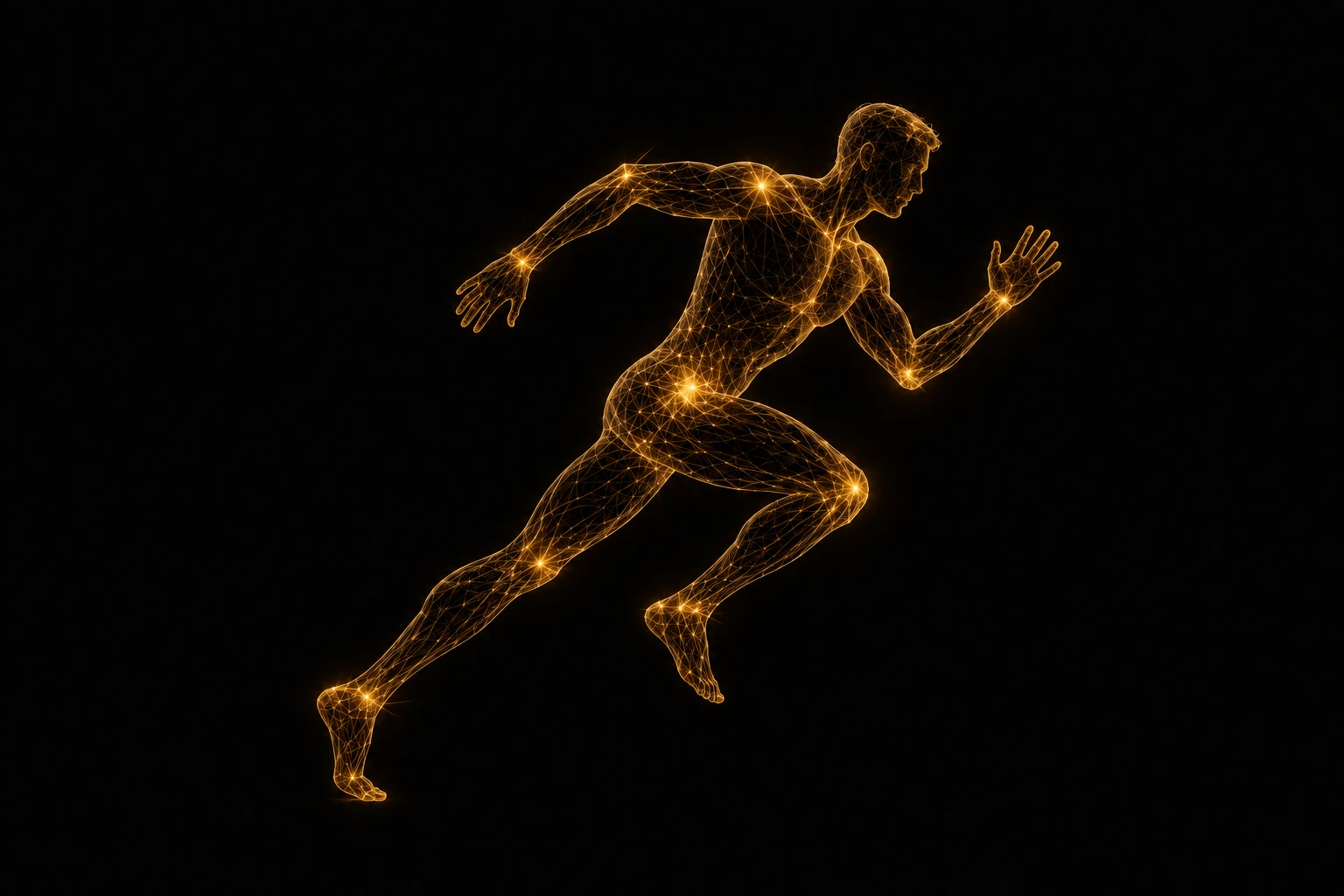
Why movement is health — and why rest almost never is.
If your back, knee, or neck has ever hurt, you've surely heard — or thought — one of these three phrases: «I'm just getting older», «I have wear and tear in the joint», or «I'd better not move it much, in case I make it worse».
We've been taught to treat the human body like a second-hand car. We think every step «wears down the tire», every bend «wears out the hinge», and that at the first sign of discomfort, the sensible thing is to park the vehicle in the garage and stay still.
There's a problem with that logic: the human body isn't a machine. It's a living organism. Machines wear out when you use them. Living beings regenerate when you use them — and deteriorate when you leave them still.
If you want to understand why movement is the indisputable foundation of NEXUS's philosophy, forget about calories, gyms, and 10,000 steps for a moment. What happens to your body when it stays still is far more fascinating — and simpler — than you think.
NEXUS quick answer · Why is movement health? Because your joints don't receive direct blood supply: they're nourished through joint imbibition, a process that only activates when you compress and release the tissue by moving. Your brain, on top of that, needs constant movement signals to keep its body map up to date; when those signals go quiet from inactivity, it interprets the area as unsafe and generates what we at NEXUS call sedentary pain: a protective signal, not a real injury. In short: sedentary behavior isn't rest, it's biological deprivation.
1. Your spine doesn't feed through your mouth: the sponge and joint imbibition
How does cartilage get nourished if it has no arteries?
Picture a kitchen sponge. If you leave it on the counter untouched for three weeks, it turns rigid, hard, rough. If you try to bend it suddenly while dry, it cracks. To make it flexible again, it's not enough to run water over it once: you have to squeeze and release it repeatedly under the tap so the water reaches its core.
Your joints, your cartilage, and the discs in your spine work exactly like that sponge. They have no arteries carrying blood and oxygen to every corner. They're nourished through a process science calls imbibition, which in plain terms simply means this: they only absorb nutrients when you squeeze and release them.
Every time you bend down, walk, twist your torso, or stretch, you're «squeezing the sponge». You push out accumulated waste while rehydrating the tissue with clean fluid. That's literally how cartilage gets fed: not through your mouth, but through movement.
This isn't just a nice metaphor: a review published in Current Rheumatology Reviews explains that, lacking blood vessels, cartilage depends on fluid diffusion and convection to get nourished — and that dynamic loading (compressing and releasing, as in walking) boosts that nutrient flow, while prolonged static compression (like staying still) reduces it.[1]
NEXUS truth: Your joint doesn't hurt because you're using it too much. It often hurts because you're dehydrating it to death by keeping it still.
Flip the switch and see what happens inside the joint.
Without compression, fluid stagnates: cartilage receives less and less nourishment.
Every compression pumps clean fluid in and pushes waste out — this is how cartilage gets fed.
2. Your brain's GPS: why sedentary behavior generates pain
The classic office example: eight hours seated and the signal that goes dark
Think of your brain as the control center of a satellite network. So you can move your hand, your foot, or your lower back without falling over, it needs a very specific map (yes, like Google Maps) of exactly where every millimeter of your body is, every second.
How does that map stay updated? With movement. Every time you move a joint, thousands of sensors send the brain a signal: «here's the shoulder, it's working fine, movement is safe».
But if you spend eight hours sitting at a computer, in the same posture, typing with hunched shoulders and your eyes fixed on the screen, that signal goes dark. The area turns blurry on the brain's map. As the map fogs over, you feel the same kind of pain as when you stand up from your chair at six in the evening and notice your back feels «stiff» without having made any real physical effort.
And what does a driver do on a mountain road when they suddenly hit thick fog? They slam the brakes and switch on the hazard lights. Your brain does exactly the same thing: when it loses the signal from a part of your body because you've gone hours without moving it, it gets scared. Since it doesn't know whether that area is safe, it «switches on the hazard lights» — generating tension, stiffness, or pain. Not to harm you, but to force you to stop because it can't see the road clearly.
This isn't poetic license either: in pain neuroscience it's well documented that chronic pain is associated with a reorganization of the cortical maps that represent the body — a phenomenon the scientific literature calls «cortical smudging». The longer pain has been established, the greater that disorganization; and normalizing those maps, through gradual movement and sensory work, directly reduces pain.[2]
MOVING
SEDENTARY
The less you move, the weaker the signal your body sends to the brain.
NEXUS truth: Pain isn't always a torn muscle or worn-down bone. It's often just a brain flying blind, trying to protect what it's forgotten how to map.
3. Movement within the NEXUS biopsychosocial model
Body: tissue that regenerates with the right stimulus
You've already seen it: cartilage, discs, and synovial tissue respond to movement the same way the sponge responds to water. That's the bio part — the most visible, but only a third of the story.
Mind: fear of movement and kinesiophobia
If we've already covered what pain is and kinesiophobia in the Journal, it's because this is where the Movement pillar turns psychological. When something hurts, the instinctive reaction is to stop moving it. But less movement means less signal for the brain, more fog on the map, and — paradoxically — more sensitivity to pain. Fear of moving doesn't protect the joint: it feeds the cycle that keeps it trapped.
A 2023 systematic review analyzed 17 studies with more than 1,300 people with chronic low back pain and found that exercise programs — particularly Pilates and progressive strengthening — reduce kinesiophobia.[3] That said, the authors themselves call for larger, higher-quality studies before drawing definitive conclusions — something common in pain science, and worth communicating honestly rather than with absolute headlines.
Environment: movement as a shared language
And then there's the social piece, the part that's almost never mentioned: almost all meaningful human movement happens in company. Walking with someone, playing with your kids, carrying the groceries, dancing at a wedding. Movement isn't just biomechanics — it's also how you take part in the world around you. When fear or pain pull you out of those moments, you don't just lose joint range: you lose shared life.
This is exactly why, at NEXUS, we don't separate «the physical» from «the mental» and «the social». They're the same story, told from three angles.
4. What if I already have osteoarthritis?
This is probably the most common objection — and the most understandable one. If a doctor or a family member ever told you «you have wear and tear, be careful», it's only logical that you'd move less out of fear of «wearing it down» further. The problem is that the strongest evidence available today says exactly the opposite.
A meta-analysis published in The BMJ in October 2025, which pooled 217 clinical trials with 15,684 participants with knee osteoarthritis, found that aerobic exercise — walking, cycling, swimming — was the intervention most likely to be the best option for reducing pain and improving function, ahead of other types of exercise.[4] And a key data point for anyone afraid: none of the exercise modalities analyzed increased adverse events compared with doing nothing.
One important detail: this doesn't mean «push through the pain and carry on». It means that moving within a tolerable range, through low-intensity, low-impact activities — walking, cycling, swimming — with progression tailored to you, is, according to the available evidence, safer and more effective than rest. If you have a diagnosed condition, the right question isn't «should I move or not?», but «how should I move, and when should I progress?». That's where a professional who assesses your specific case makes the difference over a generic template from the internet — this article included.
5. Where to start: four low-threshold movements
You don't need a twelve-week training plan to start «squeezing the sponge» and clearing the fog from your brain's map. What you need is consistency in small actions:
- Walk for 10 minutes after eating. It's gentle aerobic activity, it supports joint imbibition, and it requires no equipment or planning.
- Change position every 30-45 minutes if you work seated. You don't need to get up and exercise: just stop acting like a statue if you don't want to become one — stretch your legs, rotate your torso, stand up for 60 seconds — to send your brain a fresh signal from that area.
- Explore «forgotten» ranges in the morning. Torso rotations, hip mobility, dynamic shoulder stretches: two or three minutes are enough to reactivate the body map before the day begins.
- Progress gradually, not all-or-nothing. If you've gone months without moving, the goal isn't to «tough out» an intense session on day one. It's to expose yourself a little more each week, within a tolerable level of discomfort, until your body — and your brain — trust movement again.
Frequently asked questions about movement and health
Can I move if I have osteoarthritis, or will it hurt me more?
According to the most recent evidence (217 clinical trials, more than 15,000 participants), moderate aerobic exercise — walking, swimming, cycling — doesn't increase adverse events in people with knee osteoarthritis and is, in fact, one of the most effective interventions for reducing pain. The key is adapting the pace and load to your case, not avoiding movement altogether.
How much do I need to move each day if I have an office job?
It's not about offsetting eight hours of sitting with one hour at the gym. Movement micro-breaks every 30-45 minutes — standing up, changing position, walking for a couple of minutes — have more impact on the body map's fog than a single isolated session at the end of the day.
Does pain when I move always mean I'm hurting myself?
Not necessarily. You need to distinguish real alarm pain — acute, with swelling, following trauma, that disables you — from protective sensitization. When in doubt, a professional assessment helps tell them apart; moving within a tolerable level of discomfort is, in general, not the same as injury.
How long does it take the body to notice the benefits of moving more?
Joint nutrition improves with every session — it's almost immediate. Deeper changes, like the reorganization of the brain map or losing the fear of movement, usually need several weeks of consistency. It's a gradual process, not a switch.
Can I start exercising with just this information, without supervision?
This article is for educational purposes and doesn't replace an individualized assessment. If you have an injury, a medical condition, or haven't moved much in a long time, a physiotherapist or another registered healthcare professional can help you start safely and in a way that's adapted to your case.
Conclusion: starting over
At NEXUS, we don't believe in rigid protocols, or that everyone needs to bench press 100 kilos. We believe in reclaiming the freedom of your own biology.
If you've had discomfort for a while, or you feel like your body is «rusty», the solution is almost never total rest on the couch. The solution is to gradually give your brain back its confidence and your tissues their hydration: moving a little more today than yesterday, changing position in your chair, exploring ranges you'd forgotten about.
Remind your nervous system that your body isn't a set of faulty parts, but an intelligent nexus designed for dynamism.
«We don't move because we're healthy. We're healthy because we move.»
Movement is the first of the six pillars that hold up NEXUS. In the Journal, you can already read about the biopsychosocial approach, what pain is, and kinesiophobia.
References
- [1]Jackson AR, Gu WY. Transport Properties of Cartilaginous Tissues. Current Rheumatology Reviews. 2009.
- [2]Moseley GL, Flor H. Targeting Cortical Representations in the Treatment of Chronic Pain. Neurorehabilitation and Neural Repair. 2012.
- [3]Effects of exercise/physical activity on fear of movement in people with spine-related pain: a systematic review. Frontiers in Psychology. 2023.
- [4]Comparative efficacy and safety of exercise modalities in knee osteoarthritis: systematic review and network meta-analysis. The BMJ. 2025.
Did you like this article?