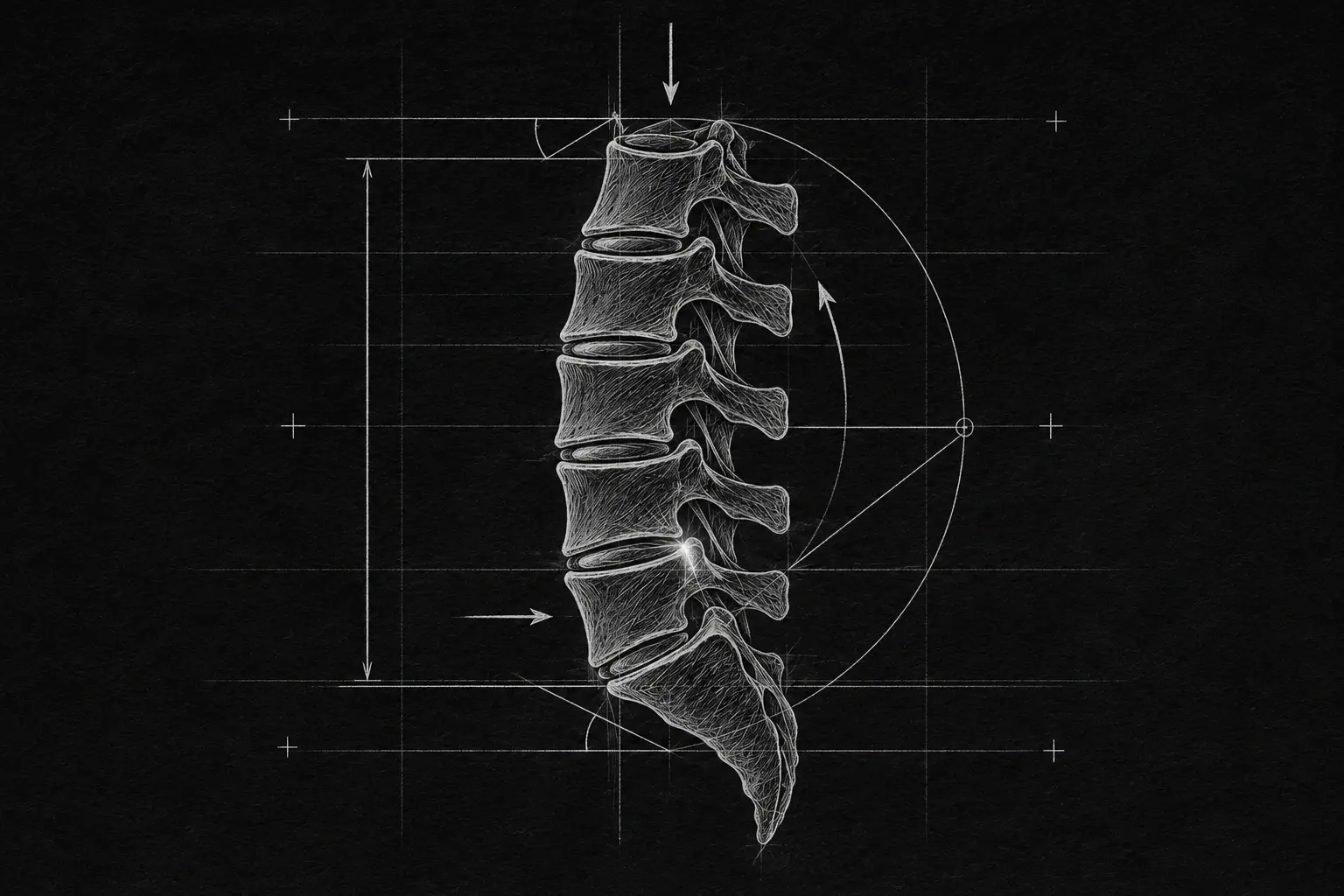
You’ve had pain in your lower back for weeks —or years— and you’ve heard it all: “wear and tear”, “strengthen your core”, “better not move”. This guide to chronic low back pain separates what we know from what gets repeated without evidence.
Looking for what to do? Go straight to the recovery plan
- Trouble passing urine or controlling bladder or bowels, or numbness between the legs (genital or anal area).
- Weakness that keeps getting worse in one or both legs.
- Fever or feeling unwell with severe back pain.
- Pain after a hard blow or a significant fall.
- A history of cancer, or unexplained weight loss.
- Constant night pain that doesn’t change with position.
What chronic low back pain is
We talk about chronic low back pain when discomfort in the lower back lasts more than three months.[5] “Non-specific” doesn’t mean “imaginary” or “hopeless”: the pain comes from several factors adding up, not from a broken part.[1]
See more
That’s why treatment is also a sum. (We develop that idea in the biopsychosocial approach to pain.)
A minority of episodes become persistent: this guide is about that minority and how to help.
Lumbar anatomy: your back, in layers
Tap each layer (or the figure itself) to see what it is, what happens to it when it hurts… and above all, what it doesn’t mean.
Bones: the structure that holds you up
What it is. Five lumbar vertebrae (L1–L5) stacked in a gentle curve, the lumbar lordosis. They carry much of the trunk’s load and protect the nerves running down the canal.
When it hurts. With age, degenerative changes appear. They are very common and usually go unnoticed.[2]
Careful. It doesn’t mean: “my spine is worn out, that’s why it hurts”.
Discs: living shock absorbers
What it is. Between each pair of vertebrae sits a disc: a tough fibrous ring around a gel-like core. It spreads load and allows movement.
When it hurts. Bulges, protrusions and dehydration show up on scans of a great many people. In people without pain, disc degeneration goes from 37% at age 20 to 96% at age 80.[2]
Careful. It doesn’t mean: “a disc has slipped out”. Disc bulges are very common in people without pain too.[2]
Ligaments and capsules: the sensors
What it is. Bands of tissue that join the vertebrae and give stability. They’re full of receptors that tell the brain about position and movement.
When it hurts. They can get irritated after strain or sustained postures, and often settle with time and gradual movement.
Careful. It doesn’t mean: “something is broken or unstable” just because you feel stiffness or hear clicks when you move.
Muscles: a team, not a soloist
What it is. Multifidus and erector muscles behind, abdominals and psoas in front, with glutes and hips as partners. They work together and adapt to what you ask of them.
When it hurts. Progressive exercise is a core recommendation of the WHO[3] and NICE[7] guidelines.
Careful. It doesn’t mean: “I have one weak muscle or a knot that’s the cause”. There’s rarely a single culprit.
Nerves and nervous system: the alarm
What it is. Nerve roots exit between each vertebra. But pain isn’t just the signal of an injury: it is an experience shaped by biological, psychological and social factors[8] (we explain it in what is pain?).
When it hurts. In persistent pain the alarm gets more sensitive: it can fire with less load than before, without the tissue being worse.[9]
Careful. It doesn’t mean: “it’s all in my head”. The pain is real; what changes is how sensitive the system is.
What your scan does (and doesn’t) say
If you’ve had an imaging test, the report may say “degeneration”, “bulge” or “protrusion”: it sounds serious. See how often they appear in people who do not have low back pain:
| Imaging finding | At age 20 | At age 80 |
|---|---|---|
| Disc degeneration | 37 % | 96 % |
| Disc bulge | 30 % | 84 % |
| Disc protrusion | 29 % | 43 % |
| Annular fissure | 19 % | 29 % |
Each percentage shows the share of people without low back pain who had that finding on imaging, at each age. Data from a review of 33 studies with 3,110 people.[2]
Something showing on imaging doesn’t prove it is the cause of your pain: what matters is whether it fits your story and your examination.[10]
Ordering an MRI “straight away”, without warning signs, does not improve the outcome.[11]
See more
A finding on a scan doesn’t prove it’s the cause of your pain: what matters is whether it fits your story and your examination. That said, some findings (such as disc bulges or extrusions) are clearly more common in people aged 50 or under who have pain, although they also appear in people without pain: imaging isn’t ignored, it’s interpreted in context.[10]
And ordering an MRI “just in case”, without warning signs, doesn’t improve outcomes: trials comparing immediate imaging with usual care find no difference in pain or function.[11]
How long low back pain lasts: how it changes over time
Most acute episodes improve markedly in the first six weeks, and then the pace slows.[12] This is what a meta-analysis of 33 cohorts (11,166 people) with recent acute low back pain measured:
Start (week 0): 52 out of 100
Average pain ≈ 52/100 in these cohorts. It’s the starting point everything else is measured from.
6 weeks (week 6): 23 out of 100
−29 points since the start (≈ −56%). This is where most of the improvement is: 29 of the 46 points gained in the first year, almost two thirds. That’s why, in a recent episode, the worst usually passes soon.
6 months (week 26): 12 out of 100
−40 points since the start (≈ −77%). Improvement continues, but much more slowly. If pain lingers, it’s worth checking what keeps it going.
1 year (week 52): 6 out of 100
−46 points since the start (≈ −88%). On average, recent acute pain ends up at low levels. Some people don’t follow the average: that isn’t your fault.
Pooled means of recent acute-pain cohorts (33 cohorts, 11,166 people), 0–100 scale. Point gains and percentages are simple arithmetic on those means.
Each bar is the average pain of many people, not your own path: yours will be more uneven, with good and bad days, and that’s normal.
See more
Why it persists: load, capacity and alarm
Your back receives a load (effort, postures, stress, poor sleep) and has a capacity (strength, fitness, rest, confidence). When the load exceeds capacity, the system gets irritated; and in persistent pain the alarm becomes more sensitive. Play with the scale:
Irritation zone
The load exceeds what your back can take right now. It isn’t that something is breaking: the system is over-protecting. Here it helps to step the load down while you build capacity gradually.
Balance zone
Load and capacity are about even. It’s the best moment to progress calmly: small increases in load that your back can handle.
Reserve zone
You have headroom. This is where your back gets more resilient: use it to build strength and return to what you’d stopped doing.
Illustrative model: the numbers (0 to 100 and the +35% for a sensitised alarm) are there to show the idea; they are not clinical data.
There are two levers, not one: raise capacity (train, sleep, gain confidence) and pace the load, without waiting for the pain to go away.
Low back pain myths: five ideas worth letting go of
Tap each card to turn it over and see what the evidence says.
“My back is worn out.”
Changes in discs and joints are part of normal ageing and show up in a great many people without pain.[2] A spine with changes isn’t a spine that inevitably has to hurt.
“I need an MRI to know what’s wrong.”
It almost never points to a single cause. Guidelines don’t recommend routine imaging, unless there are warning signs or the result would really change treatment.[7]
“My back hurts because of bad posture.”
An umbrella review of 41 systematic reviews found no consensus on whether postures or physical exposures cause low back pain: associations exist, but no causal explanation.[13] There’s no “perfect posture” that shields the back, and avoiding “wrong” postures doesn’t guarantee you’ll prevent pain. What does tend to help is varying your posture: the body is made to move, and spending many hours in the same position can get uncomfortable.
“My spine is unstable and I need to brace my abs to protect it.”
Apart from specific and uncommon cases (serious structural instability, trauma), the feeling of “instability” or stiffness does not by itself mean a loose vertebra that needs to be “locked”: it can reflect a more sensitive nervous system.[9] And motor control exercise hasn’t been shown to be clearly better than other types of exercise.[14]
“If this doesn’t get better, surgery is my only option.”
In chronic low back pain attributed to the disc, fusion surgery hasn’t shown a clear advantage over non-surgical treatment.[15] Surgery is kept for specific cases, such as a progressive neurological deficit or a specific structural pathology, assessed by a specialist.
Chronic low back pain treatment: what actually helps
Not every treatment has the same backing. This is how the international guidelines rank them, the 2023 World Health Organization (WHO) one[3] and the NICE one[7]: from the most recommended to what is better avoided. Tap each one.
Rung 1 · Foundations: Education and progressive movement
Tags: Education and self-management · Therapeutic exercise
- The WHO guideline recommends structured education and exercise programmes for chronic primary low back pain.[3]
- NICE suggests simple support for people likely to recover soon, and exercise programmes (with or without manual therapy) for those at higher risk of a poor outcome.[7]
Rung 2 · Add-ons: Occasional, symptom-focused support
Tags: Manual therapy · Psychological therapy · NSAIDs, with caution
- The WHO lists physical therapies (spinal manipulation, massage), psychological support (such as cognitive-behavioural therapy) and non-steroidal anti-inflammatories.[3]
- A meta-analysis of 97 trials (13,136 adults) found that cognitive-behavioural therapy and pain education, alongside physiotherapy, bring clinically important improvements in function by the end of treatment.[16] Spinal manipulation, across 47 trials (9,211 people), gives pain relief and functional improvement comparable to other recommended therapies.[17]
- They work best as part of an overall plan rather than as a stand-alone fix: they ease symptoms to make movement and training easier.
- Any drug treatment should be assessed and decided with your doctor, weighing risks and duration (the WHO recommendation on anti-inflammatories does not apply to older people).
Rung 3 · Use with caution: Little support, or risks that outweigh benefits
Tags: Routine imaging · Opioids · Braces and traction
- NICE advises against routine imaging in non-specialist settings.[7]
- The WHO doesn’t recommend, for most people in most contexts, opioids, lumbar braces or belts or traction.[3]
- Real-world practice often goes the other way: first-line treatments are underused while imaging, rest, opioids, injections and surgery are overused.[18]
How much does exercise help low back pain?
The most recent Cochrane review of exercise in chronic low back pain (249 trials) finds that it reduces pain by a clinically important amount compared with no treatment or usual care. Pick how much it hurts today and see where it would take you.
Pain
Exercise versus other conservative care. 9.1 (5.6 to 12.6). Certainty: low.
Exercise versus no treatment, usual care or placebo. 15.2 (12.2 to 18.3). Certainty: moderate.
Source: 2021 Cochrane review (0 to 100 scale, first follow-up after treatment).[19]
What to take away: exercise is the foundation of treatment[3][7] and reduces pain by a clinically important amount compared with no treatment.[19] Compared with other conservative care, the advantage is smaller.
Recovery plan in phases: exercise and movement
Everyone is different, but the path tends to follow this order. These are examples to understand the logic, not a personal prescription.
Phase 1 · Understand and settle (≈ weeks 0–2)
Goal. Turn the alarm down: understand what’s going on, reduce fear and keep moving without forcing it.
What you can do:
- Carry on with daily life, adapting loads rather than stopping
- Walk at a comfortable pace, in short bouts
- Change position often; local heat or slow breathing can help you relax
Phase 2 · Move with confidence (≈ weeks 2–8)
Goal. Regain range of movement and return to the actions you were avoiding out of fear.
What you can do:
- Gentle mobility within comfort
- Progressive walking and gradual exposure to controlled bending or twisting
- Gradually return to what you avoid (bending, twisting, light lifting)
Phase 3 · Build capacity (≈ weeks 8–16)
Goal. Gain strength and load tolerance so your back can take more.
What you can do:
- Progressive hip, trunk and leg strength
- Use everyday loads (shopping, gardening, kids) as training
- Aerobic exercise (brisk walking, cycling, swimming) to taste
Phase 4 · Maintain and prevent flare-ups (≈ from week 16)
Goal. Make it a habit and have a plan for bad days.
What you can do:
- A realistic exercise routine: the one you can keep up
- A “bad day” plan: what you reduce and what you keep
- Check in on sleep, stress and work from time to time
The full map: body, mind and surroundings
Persistent low back pain almost never has a single cause: body, mind and surroundings add up. That’s why what works best looks at all three at once.
What I see in clinic
In my practice, what I have seen repeat most is not an injury: it is a story.
I sit across from people who have had pain for months or years; most of the time they bring an MRI full of frightening terms along with the conviction that their body is broken. Almost always there is something specific, like a sport or an activity they have stopped doing for fear of making things worse.
What changes things is not a technique. It is slowing down, understanding what those words really mean and, step by step, going back to what matters.
The pain does not always disappear all at once, but once you understand the process, it stops running your life.
For professionals and students
Show the technical contentEvidence tables, referral criteria and clinical practice guidelines, in technical terms.
The evidence and clinical reasoning behind the article, in technical terms. Figures come from each source’s official abstract; our own calculations are flagged. Tap an underlined abbreviation to see what it means.
Abbreviations
RCT randomised controlled trial · CI confidence interval · MD mean difference · SMD standardised mean difference · RMDQ Roland-Morris Disability Questionnaire · ODI Oswestry Disability Index · SBST STarT Back Screening Tool (screens the risk of a poor outcome) · VAS visual analogue scale for pain · NRS numeric rating scale for pain (0–10) · NSAID non-steroidal anti-inflammatory drug · MRI magnetic resonance imaging · TSK Tampa Scale for Kinesiophobia (fear of movement) · FABQ Fear-Avoidance Beliefs Questionnaire · PSEQ Pain Self-Efficacy Questionnaire · PSFS Patient-Specific Functional Scale · CSI Central Sensitization Inventory · PROMIS Patient-Reported Outcomes Measurement Information System · GIRFT Getting It Right First Time, an English NHS programme · WHO World Health Organization · NICE National Institute for Health and Care Excellence, the UK public body for clinical guidelines
Clinical assessment and prognosis
Key points: screen for red flags, stratify risk (SBST), treat with education and exercise, measure function and pain at baseline and at each review, and reassess if there is no improvement.
Clinical pathway
- ScreenRed flags and neurological signs. If cauda equina is suspected, refer immediately (see “Refer”).
- StratifyClassify the risk of a poor outcome (SBST: low, medium or high) before choosing the approach.
- TreatEducation and exercise as the base; behavioural therapy added to physiotherapy was what kept the effect on pain at mid-term (see “Treat”).
- MeasureFunction (Oswestry or Roland-Morris) and pain (VAS or numeric scale) at baseline and at each review.
- ReassessNo improvement with an adequate conservative approach: review the diagnosis and reconsider referral.
Before measuring
- Red flags
- Screening for serious pathology (fracture, malignancy, infection, cauda equina). Validity is limited: for fracture and malignancy, only a subset of the recommended flags proved informative, and a history of malignancy was the most useful (post-test probability of spinal malignancy 33%; 95% CI 22–46).[20] They are interpreted together, not in isolation.
- Imaging
- Only when serious pathology is suspected or the result will change management.[7]
Minimum set: at every visit
- Scale
- VAS 0–100 · NRS 0–10
- Relevant change
- VAS 15 · NRS 2 (or 30%)[21]
Ask about average pain over the last week: it is the recall period backed by the consensus, which recommends the numeric version (NRS).[22]
- Scale
- ODI 0–100 · RMDQ 0–24
- Relevant change
- ODI 10 · RMDQ 5 (or 30%)[21]
More points mean more disability. Pick one of the two and always use the same one.[22]
A generic measure of health-related quality of life. The consensus recommendations accept either of the two.[22]
Depending on what you find
- Scale
- 9 items
Low: 0 to 3 points in total. High: 4 or 5 on the psychosocial subscale. The rest, medium.[23]
Use it when you are about to choose the approach (step 2 of the pathway).
- Scale
- 11 items
- Relevant change
- A drop of 4 or more points[24]
It measures pain-related fear: more points, more fear. It was studied in people with chronic low back pain.[24]
Use it when they avoid movements or activities for fear of hurting themselves.
- Scale
- 2 subscales
One subscale on physical activity and one on work. Beliefs about work accounted for 23% of the variance in disability and 26% of the variance in work loss, even after allowing for pain severity.[25]
Use it when there is time off work or doubt about going back.
It measures confidence in doing activities despite the pain, not just in doing them. It is useful before and after treatment.[26]
Use it when you notice that lack of confidence holds them back more than the pain itself.
The patient picks the specific activities they find hard and scores them themselves. It is reliable, valid and responsive in low back pain.[27]
Use it when you want to set goals in their own words.
- Scale
- 0–100
A screening tool for central sensitivity syndromes. In a mixed chronic pain sample, a score of 40 separated patients with these syndromes from a comparison group (sensitivity 81%, specificity 75%).[28] It is a guide only: it is not specific to low back pain and does not prove the mechanism.
Use it when the pain is diffuse or out of proportion and comes with other symptoms, such as poor sleep or fatigue.
- Why stratify
- In the STarT Back RCT (851 patients allocated), care stratified by this risk improved disability (RMDQ) at 4 and 12 months compared with current best practice (at 12 months: difference of 1.06 points; 95% CI 0.25–1.86) and was associated with lower costs.[29]
What to look for when assessing
- What they have stopped doing
- Ask which activities they have given up because of the pain and why: the pain itself, fear, or advice they were given? The answer tells you which scale you need.
- What they think is wrong
- Explore how they explain their problem and what they were told before: what they heard from other professionals shapes their beliefs.[30]
- What they say and what they do
- Compare what they say they cannot do with what you observe: how they get up from the chair, how they undress, how they bend.
- The same scale from day one
- Record the starting value of each scale at the first visit and always use the same version and recall period, so that reviews can be compared with each other.[22]
- Real change or noise
- Before celebrating or worrying about a change, compare it with the scale’s relevant change (VAS 15 points, NRS 2, ODI 10, RMDQ 5, or 30% from baseline). They are a starting point, not an exact threshold.[21]
Treatment: certainty of evidence
Key points: therapeutic exercise is the foundation and reduces pain by a clinically important amount (moderate certainty). Pain education with physiotherapy improves function (low certainty).
Certainty of the evidence:HighModerateLow
| Intervention | What it means | Certainty | Key data |
|---|---|---|---|
| Therapeutic exercise versus no treatment, usual care or placebo | Reduces pain by a clinically important amount: it is the foundation of treatment. | Moderate | |
| Exercise versus other conservative care | Somewhat better than other conservative care, but the advantage does not reach clinical importance. | Low | −9.1MD in pain (0–100) 95% CI −12.6 to −5.6 64 studies · n = 6,295 · same review |
| Pain education + physiotherapy | The add-on with the most sustained effects on function, at least until mid-term.[16] | Low | 0.63SMD in function · mid-term 95% CI 0.25 to 1.00 No long-term data 97 RCTs · n = 13,136 · network meta-analysis |
| Behavioural therapy + physiotherapy | Only option that kept clinically important effects on pain intensity at mid-term. | High | |
| Lumbar fusion versus non-surgical treatment (discogenic pain) | Did not improve disability more than non-surgical treatment in discogenic pain. | — |
Certainty as rated by each source; “—” means it is not stated in the abstract consulted. The network meta-analysis uses physiotherapy as the reference.
- Drugs
- Oral NSAIDs with caution according to gastrointestinal, hepatic and cardiorenal risk;[7] opioids are not recommended as routine treatment.[3]
- Clinical communication
- Clinicians’ messages shape patients’ beliefs: in a qualitative study (n = 23), messages suggesting the back needed protection increased hypervigilance and guilt, while reassurance and advice on activity strengthened confidence.[30]
| Better to avoid | Better to say |
|---|---|
| “Your spine is worn out.” | “The changes on the scan are common with age and also show up in people with no pain.” |
| “Your back is unstable: protect it and avoid lifting.” | “Your back is strong and built to move; building activity back gradually is part of the treatment.” |
| “Rest until it settles.” | “Stay active within what you can tolerate.” |
| “If it hurts, something is damaged.” | “Persistent pain does not always mean tissue damage: the alarm system can be sensitised.” |
Illustrative phrases, written as examples.
Referral criteria
Key points: suspected cauda equina syndrome = immediate referral; another serious pathology or progressive motor deficit = prioritised assessment; no improvement = reassess and reconsider referral.
Back or leg pain of recent onset (14 days or less), or worsening, with any of these symptoms:
- Difficulty starting to urinate or altered sensation of urinary flow
- Altered perianal, perineal or genital sensation
- Severe or progressive neurological deficit in both legs
- Loss of the sensation of rectal fullness or sexual dysfunction
Surgical emergency: immediate referral to the nearest hospital for an urgent MRI, following the GIRFT national pathway. With sudden-onset sciatica that is bilateral (or becomes so) and none of those symptoms: urgent referral (within two weeks) to a musculoskeletal triage service.[4]
Fracture, malignancy, infection or systemic inflammatory process: prioritised medical assessment. Isolated red flags have limited diagnostic value and are interpreted together.[20]
Prioritised specialist assessment, without waiting for conservative treatment to run its course.
If there is no improvement with an adequate conservative approach, reassess the diagnosis and prognostic factors and reconsider referral.
Official guidelines and documents
Key points: the WHO guideline (2023) and NICE NG59 (updated 2026) agree: education and exercise as the foundation, stratified care and no routine imaging in non-specialist settings.
It makes 24 recommendations, all conditional, with certainty of evidence from moderate to very low. Among the 14 interventions not recommended for most people in most contexts are opioids, lumbar braces and traction. The NSAID recommendation does not apply to older people.[3]
- 37 non-surgical interventions assessed
- 24 recommendations
- 1 good-practice statement
- 12 with no recommendation
- 14 not recommended
Risk-stratified care, exercise with or without manual therapy for higher-risk patients, and no routine imaging in non-specialist settings.[7]
Open the original documentnice.org.ukKeep exploring
What if your situation doesn’t quite fit this guide? A few pointers to tell the difference:
 PhysiotherapyAug 16, 2026 What is pain? Your body’s alarm system Read more
 PhysiotherapyAug 19, 2026 Kinesiophobia and fear of movement: what it is and how to overcome it Read more
Frequently asked questions about chronic low back pain
Does chronic low back pain go away?
Many people improve significantly, although flare-ups are common.[1] The realistic goal: reduce pain, get back to what matters and have a plan for bad days.
See more
Many people improve a lot, although flare-ups are common.[1] Rather than “being cured completely”, the realistic goal is to reduce pain and disability, get back to the activities that matter to you and have a plan for bad days.
Is walking good exercise for low back pain?
It’s an excellent starting point: accessible, easy to dose and to fit into your routine. There is no miracle exercise: the best one is the one you enjoy and can keep up.
See more
It’s an excellent starting point: it’s accessible, easy to dose and easy to fit into your routine. A meta-analysis of 19 trials in chronic or recurrent low back pain found that walking or running has a small effect on pain and disability compared with no treatment, although it is less effective than other interventions.[31] There’s no miracle exercise: the best one is the one you enjoy and can keep up.
Do medications cure chronic low back pain?
No: they act as short-term support. The WHO[3] and NICE[7] consider anti-inflammatories with caution; any drug should be prescribed by your doctor.
See more
No: they act as short-term support. Both the WHO[3] and NICE[7] (the UK body for clinical guidelines) consider anti-inflammatories (NSAIDs) for low back pain, with caution about their risks (the WHO recommendation does not apply to older people). The WHO doesn’t recommend opioids as routine treatment and, in sciatica, NICE advises against gabapentinoids and recommends against opioids in chronic sciatica. Any drug should be prescribed and monitored by your doctor.
When should I go to emergency care for low back pain?
Go to emergency care today with trouble urinating or controlling your bladder or bowels, loss of sensation in the genital or anal area, or worsening weakness in the legs.[4] With the other signs, see your doctor as soon as possible.
See more
Go to emergency care today if you have trouble passing urine or controlling your bladder or bowels, numbness in the genital or anal area, or weakness in your legs that keeps getting worse: they can point to cauda equina syndrome, a medical emergency.[4] With a hard blow or a history of cancer, see your doctor as soon as possible: these are the signs with most value for detecting fracture and cancer.[20] With fever, unexplained weight loss or constant night pain, also see your doctor; if you also feel very unwell, go to emergency care.
Does this guide replace a professional assessment?
No. It is educational: with warning signs or very limiting pain, see a licensed health professional.
See more
No. Its purpose is educational. If you have warning signs or the pain limits you significantly, see a licensed health professional for an individual assessment.
Want us to look at it together?
Understanding what’s going on in your back is the first step. The next is designing, with you, a plan that fits your body, your work and your life.
Our contactReferences
Show the 31 references
- [1]Hartvigsen J, Hancock MJ, Kongsted A, Louw Q, Ferreira ML, Genevay S, et al. What low back pain is and why we need to pay attention. Lancet. 2018;391(10137):2356-2367.Review↗
- [2]Brinjikji W, Luetmer PH, Comstock B, Bresnahan BW, Chen LE, Deyo RA, et al. Systematic literature review of imaging features of spinal degeneration in asymptomatic populations. AJNR Am J Neuroradiol. 2015;36(4):811-816.Systematic review↗
- [3]World Health Organization. WHO guideline for non-surgical management of chronic primary low back pain in adults in primary and community care settings. Geneva: World Health Organization; 2023. ISBN 978-92-4-008178-9.Guideline↗
- [4]Getting It Right First Time (GIRFT), NHS England. Spinal surgery: National suspected cauda equina syndrome (CES) pathway. London: NHS England; March 2026 update (first published February 2023).Guideline↗
- [5]Nicholas M, Vlaeyen JWS, Rief W, Barke A, Aziz Q, Benoliel R, et al.; IASP Taskforce for the Classification of Chronic Pain. The IASP classification of chronic pain for ICD-11: chronic primary pain. Pain. 2019;160(1):28-37.Consensus↗
- [6]Ferreira ML, de Luca K, Haile LM, et al.; GBD 2021 Low Back Pain Collaborators. Global, regional, and national burden of low back pain, 1990–2020, its attributable risk factors, and projections to 2050: a systematic analysis of the Global Burden of Disease Study 2021. Lancet Rheumatol. 2023;5(6):e316-e329.Review↗
- [7]National Institute for Health and Care Excellence. Low back pain and sciatica in over 16s: assessment and management (NG59). Last updated 29 July 2026 (first published 30 November 2016).Guideline↗
- [8]Raja SN, Carr DB, Cohen M, Finnerup NB, Flor H, Gibson S, et al. The revised International Association for the Study of Pain definition of pain: concepts, challenges, and compromises. Pain. 2020;161(9):1976-1982.Consensus↗
- [9]Woolf CJ. Central sensitization: implications for the diagnosis and treatment of pain. Pain. 2011;152(3 Suppl):S2-S15.Review↗
- [10]Brinjikji W, Diehn FE, Jarvik JG, Carr CM, Kallmes DF, Murad MH, et al. MRI findings of disc degeneration are more prevalent in adults with low back pain than in asymptomatic controls: a systematic review and meta-analysis. AJNR Am J Neuroradiol. 2015;36(12):2394-2399.Meta-analysis↗
- [11]Chou R, Fu R, Carrino JA, Deyo RA. Imaging strategies for low-back pain: systematic review and meta-analysis. Lancet. 2009;373(9662):463-472.Meta-analysis↗
- [12]Menezes Costa L da C, Maher CG, Hancock MJ, McAuley JH, Herbert RD, Costa LOP. The prognosis of acute and persistent low-back pain: a meta-analysis. CMAJ. 2012;184(11):E613-E624.Meta-analysis↗
- [13]Swain CTV, Pan F, Owen PJ, Schmidt H, Belavy DL. No consensus on causality of spine postures or physical exposure and low back pain: a systematic review of systematic reviews. J Biomech. 2020;102:109312.Systematic review↗
- [14]Saragiotto BT, Maher CG, Yamato TP, Costa LOP, Menezes Costa LC, Ostelo RWJG, et al. Motor control exercise for chronic non-specific low-back pain. Cochrane Database Syst Rev. 2016;(1):CD012004.Cochrane review↗
- [15]Bydon M, De la Garza-Ramos R, Macki M, Baker A, Gokaslan AK, Bydon A. Lumbar fusion versus nonoperative management for treatment of discogenic low back pain: a systematic review and meta-analysis of randomized controlled trials. J Spinal Disord Tech. 2014;27(5):297-304.Meta-analysis↗
- [16]Ho EK, Chen L, Simic M, Ashton-James CE, Comachio J, Wang DXM, et al. Psychological interventions for chronic, non-specific low back pain: systematic review with network meta-analysis. BMJ. 2022;376:e067718.Meta-analysis↗
- [17]Rubinstein SM, de Zoete A, van Middelkoop M, Assendelft WJJ, de Boer MR, van Tulder MW. Benefits and harms of spinal manipulative therapy for the treatment of chronic low back pain: systematic review and meta-analysis of randomised controlled trials. BMJ. 2019;364:l689.Meta-analysis↗
- [18]Foster NE, Anema JR, Cherkin D, et al. Prevention and treatment of low back pain: evidence, challenges, and promising directions. Lancet. 2018;391(10137):2368-2383.Review↗
- [19]Hayden JA, Ellis J, Ogilvie R, Malmivaara A, van Tulder MW. Exercise therapy for chronic low back pain. Cochrane Database Syst Rev. 2021;9:CD009790.Cochrane review↗
- [20]Downie A, Williams CM, Henschke N, Hancock MJ, Ostelo RW, de Vet HC, et al. Red flags to screen for malignancy and fracture in patients with low back pain: systematic review. BMJ. 2013;347:f7095.Systematic review↗
- [21]Ostelo RW, Deyo RA, Stratford P, Waddell G, Croft P, Von Korff M, Bouter LM, de Vet HC. Interpreting change scores for pain and functional status in low back pain: towards international consensus regarding minimal important change. Spine (Phila Pa 1976). 2008;33(1):90-94.Consensus↗
- [22]Chiarotto A, Boers M, Deyo RA, Buchbinder R, Corbin TP, Costa LOP, et al. Core outcome measurement instruments for clinical trials in nonspecific low back pain. Pain. 2018;159(3):481-495.Consensus↗
- [23]Hill JC, Dunn KM, Lewis M, Mullis R, Main CJ, Foster NE, Hay EM. A primary care back pain screening tool: identifying patient subgroups for initial treatment. Arthritis Rheum. 2008;59(5):632-641.Validation study↗
- [24]Woby SR, Roach NK, Urmston M, Watson PJ. Psychometric properties of the TSK-11: a shortened version of the Tampa Scale for Kinesiophobia. Pain. 2005;117(1-2):137-144.Validation study↗
- [25]Waddell G, Newton M, Henderson I, Somerville D, Main CJ. A Fear-Avoidance Beliefs Questionnaire (FABQ) and the role of fear-avoidance beliefs in chronic low back pain and disability. Pain. 1993;52(2):157-168.Validation study↗
- [26]Nicholas MK. The pain self-efficacy questionnaire: taking pain into account. Eur J Pain. 2007;11(2):153-163.Validation study↗
- [27]Nazari G, Bobos P, Lu S, Reischl S, Almeida PH, MacDermid JC. Psychometric properties of the Patient-Specific Functional Scale in patients with low back pathology: a systematic review and meta-analysis. Physiother Can. 2022;74(1):6-14.Meta-analysis↗
- [28]Neblett R, Cohen H, Choi Y, Hartzell MM, Williams M, Mayer TG, Gatchel RJ. The Central Sensitization Inventory (CSI): establishing clinically significant values for identifying central sensitivity syndromes in an outpatient chronic pain sample. J Pain. 2013;14(5):438-445.Validation study↗
- [29]Hill JC, Whitehurst DG, Lewis M, Bryan S, Dunn KM, Foster NE, et al. Comparison of stratified primary care management for low back pain with current best practice (STarT Back): a randomised controlled trial. Lancet. 2011;378(9802):1560-1571.Clinical trial↗
- [30]Darlow B, Dowell A, Baxter GD, Mathieson F, Perry M, Dean S. The enduring impact of what clinicians say to people with low back pain. Ann Fam Med. 2013;11(6):527-534.Qualitative study↗
- [31]Pocovi NC, de Campos TF, Christine Lin CW, Merom D, Tiedemann A, Hancock MJ. Walking, cycling, and swimming for nonspecific low back pain: a systematic review with meta-analysis. J Orthop Sports Phys Ther. 2022;52(2):85-99.Meta-analysis↗