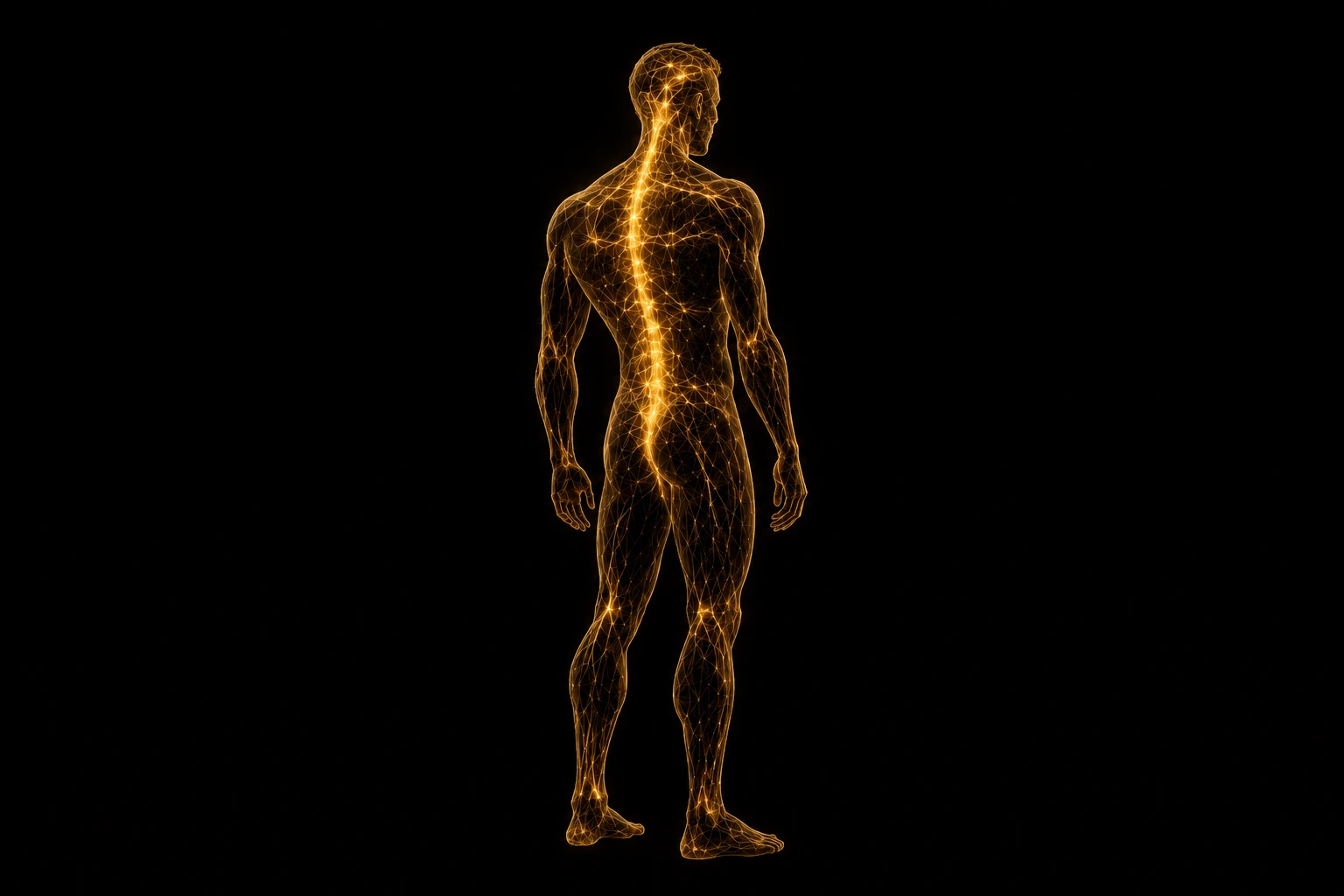
Every emotion you don't process, your body turns into a symptom. If you've ever felt your heart race without having run, a knot in your stomach before a meeting, or simply lost your appetite for days without being ill, you've surely heard —or thought— one of these lines: “It's just stress, it's nothing,” “Relax, it's all in your head,” or “It'll pass, no need to dwell on it.”
We've been taught to separate mind from body as if they were two tenants living on different floors who never cross paths in the elevator. As if whatever you feel emotionally stayed locked away in some abstract corner of your head, without touching anything else.
There's a problem with that separation: it doesn't exist. Your nervous system doesn't distinguish between a physical threat —a car braking hard in front of you— and an emotional or psychological one —a message from your boss at eleven at night. Both activate exactly the same circuit. And that circuit doesn't stay in your head: it travels down to your heart, your gut, your muscles, and your immune system. We call this biological process, by which psychological distress shows up in physiology, somatization.
If you want to understand why the Mind pillar is just as non-negotiable as the Movement pillar → within NEXUS's philosophy, set aside the idea of “willpower” or “just push through it” for a moment. What happens to your body when your mind is overloaded is pure physiology —and it's much easier to understand than you think.
Why does the mind affect the body? Because your autonomic nervous system runs on two pedals, not one: the sympathetic (which activates you, the accelerator) and the parasympathetic (which calms you, the brake). Sustained anxiety keeps the accelerator pressed down longer than your body can sustain, producing real tachycardia, muscular somatization, and digestive discomfort. And when the nervous system interprets the threat as never-ending, the body enters a low-grade inflammatory state. What we call sustained exhaustion or low mood isn't weakness: it's a psychosomatic response and a biological alarm that's still switched on. In short: the mind-body connection isn't a metaphor, it's a shared nervous and immune circuit.
The accelerator and the brake: your autonomic nervous system
Why does your heart race in a meeting that isn't dangerous? Think of your autonomic nervous system as a car dashboard with two pedals, not one.
- The accelerator is the sympathetic nervous system: it activates in response to any signal of threat, real or perceived, and prepares your body to fight or flee —raises heart rate, tenses your muscles, redirects blood away from the stomach and toward the limbs, dilates your pupils.
- The brake is the parasympathetic nervous system: it's what brings you back to a state of calm, digestion, and cellular repair once the threat has passed.
The problem isn't having the accelerator —you need it, it's saved your life more than once without you noticing. The problem is never letting go of it. A phone notification, an unresolved argument, a never-ending to-do list: to your nervous system, all of that can sound like a low-volume fire alarm that never quite switches off. And an accelerator pressed fourteen hours a day, every day, wears the engine down —literally.
This isn't just a figure of speech: a meta-analysis published in Psychiatry Investigation, which pooled 37 studies on heart rate variability (HRV) —the most direct physiological marker of the balance between the sympathetic and parasympathetic systems— found that low parasympathetic activity is the most consistent finding associated with sustained psychological stress.[1] In other words: when you live stressed, your body measurably loses its ability to brake.
Your heart doesn't race because you're “overreacting.” It races because your nervous system, with good intentions, keeps mistaking a work message for a real physical danger.
Your gut is your second brain: the gut-brain axis
Why does anxiety kill your appetite or send you into non-stop eating? Have you ever felt “butterflies in your stomach” before something important? That's not just a figure of speech: it's the direct manifestation of the gut-brain axis.
Your digestive system has its own neural circuit —the enteric nervous system, with more than 500 million neurons— and it's connected bidirectionally to your brain through the vagus nerve.[2] When you experience anxiety, that pathway sends the alarm signal downward; and when your microbiota or digestion is disrupted, the signal travels upward, feeding the state of mental alertness.
That's why stress doesn't produce a single, predictable psychosomatic symptom. In some people it shuts down hunger signals entirely —the body interprets that “this isn't the time to digest, it's time to survive” and redirects energy to the muscular system. In others, the opposite happens: stress triggers food-seeking, especially foods dense in sugar and fat, as a fast —if not particularly effective long-term— way of calming the nervous system.
The evidence backs both patterns: a meta-analysis published in Health Psychology Review, which combined 54 studies with more than 119,000 participants, found that stress is, on average, associated with higher consumption of ultra-processed foods and a reduction in nutritious food intake —but with individual variability so high across studies that the authors themselves insist there's no single “correct” stress response, but several forms of regulation.[3]
The vagus nerve connects brain and gut in both directions: anxiety travels down as an alarm signal (gold dot); the state of your digestion travels up as a mental-alertness signal (green dot).
If stress kills your appetite or drives you to eat, your body isn't malfunctioning. It's using the only adaptation and survival strategy it knows in that moment.
The mind within NEXUS's biopsychosocial model
To understand how mind and body relate without oversimplifying, at NEXUS we look at health through the biopsychosocial model →, splitting it into three interconnected dimensions: biological, cognitive, and social.
Biological dimension: when emotion becomes an inflammatory marker
For a long time, depression was treated as if it were just a mood or a chemical deficit. Current neuroscientific evidence also describes it as a measurable, low-grade inflammatory state in the blood.[4]
When the body keeps inflammatory markers like C-reactive protein or interleukin-6 activated for weeks, those same molecules interfere with the neurotransmitters that regulate mood, motivation, and appetite. It's not that you “lack motivation”: your immune system, without you deciding it, redirects resources toward what it interprets as a sustained threat. It works the same way a phone enters power-saving mode and shuts down non-essential functions: appetite, concentration, and the urge to socialize all drop.
A 2024 review published in BJPsych Open, which analyzed 44 studies on inflammatory biomarkers in depression, found that elevated C-reactive protein levels consistently correlate with appetite loss and difficulty concentrating, while interleukin-6 is especially linked to anhedonia —the inability to feel pleasure.[4]
Cognitive dimension: the story you tell yourself about what you feel
The same physical symptom —a twinge in the chest, a tension headache— can feel radically different depending on the interpretation your mind builds around it.
If you interpret tachycardia as “I'm having a heart attack,” the sympathetic nervous system receives a second alarm signal —this time generated by the thought itself— and the somatization cycle feeds itself. It's exactly the same dynamic we cover in our piece on what pain is and how the brain processes it →: the brain doesn't react only to what's happening in the tissue, it reacts to what it interprets is happening.
Social dimension: why human connection regulates your physiology
A large part of your nervous system is regulated through other people, a biological phenomenon known as co-regulation —the same territory we'll be developing further down the line in the Journal's Social Relationships pillar.
A conversation with someone you trust can measurably lower your heart rate and cortisol levels. Prolonged isolation, on the other hand, keeps the alarm system more active than necessary. It's no coincidence that unwanted loneliness is one of the most consistent risk factors for both anxiety and cardiovascular disease.
When does somatization stop being passing stress?
It's essential to tell everyday acute stress —activating and even useful in short doses— apart from a sustained state of somatization that starts limiting your quality of life.
Some physical and emotional signs that call for a health professional's assessment (psychologist, psychiatrist, or your GP):
- Drastic changes in appetite or sleep patterns sustained for several weeks.
- Persistent loss of interest in activities that used to feel rewarding.
- Severe difficulty maintaining concentration on everyday tasks.
- Recurring psychosomatic symptoms —palpitations, chest tightness, digestive discomfort, tension headaches— that have already been medically ruled out at the organic level but persist.
As the Health Psychology Review meta-analysis with more than 119,000 participants confirmed, there's no single “correct” way to express stress: some people lose their appetite, some overeat, some develop insomnia, and some experience constant drowsiness. That variability isn't a flaw on your part —it's precise information about how your nervous system is managing the threat.
Asking for professional support isn't the last resort reserved for “when you truly can't take it anymore”: it follows the exact same logic as seeing a physiotherapist for persistent joint pain →, before it turns into a chronic problem. At NEXUS, we don't separate mental health from physical health.
Where to start: four anchors to regulate your autonomic nervous system
You don't need to resolve every source of stress in your life to start letting go of the accelerator. What you need is consistency with simple physiological habits:
- Breathe with the brake, not the accelerator. An exhale that's progressively longer than the inhale (for example, 4 seconds in, 6-8 seconds out) directly activates the vagus nerve and the parasympathetic system. Two minutes are enough to register physiological change.
- Use movement as a safety signal. Physical exercise directly regulates the nervous system. As we explain in why movement is health →, walking, stretching, or simply changing posture tells the brain the threat has passed.
- Protect one real conversation a day. No screens, no distractions: an interaction with human presence. Social co-regulation is one of the most powerful —and accessible— modulators of the nervous system.
- Don't wait to “hit rock bottom” to ask for help. The sooner an overloaded nervous system gets support, the less time it stays stuck in somatization mode. Asking for help early is the most efficient health strategy there is.
Follow the circle's pace: 4 seconds in, 7 seconds out. Two minutes are enough to activate the vagus nerve.
Conclusion: letting go of the accelerator
At NEXUS, we don't believe mental health is an isolated compartment, or that “toughing it out” is a physiological virtue. We believe in accurately interpreting what your nervous system has been trying to tell you through your body.
If you've had a racing heart, a closed-off stomach, or drained energy for a while, the answer is almost never “think positive” and keep going. The answer is giving your nervous system biological certainty that the danger has passed: breathing differently, moving, connecting with someone, and —when needed— asking for professional help without waiting for a crisis.
Remind your body that your mind and it aren't separate tenants, but the same house.
You don't feel anxious because you're broken. You feel anxious because your nervous system doesn't yet know the threat has passed.
Want to see how this applies to you?
Put these three pillars to the test with the 2-minute educational simulator: body, mind, and environment, applied to your specific situation.
Try the simulator →Frequently asked questions about mind, somatization, and the nervous system
Why does my heart race or do I feel short of breath with no apparent physical cause?
Because your sympathetic nervous system interpreted something —a thought, a situation, or a memory— as a threat and triggered the same physiological alert response you'd use against real physical danger. If a cardiac or respiratory cause has already been ruled out by a medical professional, you're likely experiencing an activation of the nervous accelerator without the matching brake.
Is it normal to lose your appetite from stress or anxiety?
Yes, it's one of the most common manifestations of the mind-body connection: the body interprets that it's not a time to digest but a time to stay alert, redirecting energy to the muscles. The opposite pattern —eating more than usual to seek immediate calm— is equally normal. Both are stress-management mechanisms.
Can anxiety cause real physical symptoms, not just “nerves”?
Yes, completely real ones: tachycardia, muscle tension, gastrointestinal discomfort, sweating, or dizziness are produced by the autonomic nervous system and the endocrine system. The origin being psychological or emotional doesn't mean the manifestation isn't biological and physical.
How long does it take the nervous system to calm down after sustained stress?
It varies depending on the person and how long the alarm system has stayed active. While breathing techniques and exercise produce measurable changes within minutes, restoring a stable parasympathetic balance after months of chronic stress usually takes weeks of consistency and, in many cases, professional support.
Can stress or anxiety cause back pain, neck pain, or muscle knots?
Yes. When the sympathetic nervous system stays activated, it keeps your muscles under constant tension —especially in the neck, traps, and lower back— which over time produces real, not imagined, muscle knots and pain. It's the same logic we explore in the biopsychosocial approach to pain →: sustained emotional tension is a real biomechanical factor, not an excuse.
Does this replace psychological therapy or medication?
No. This article explains the physiology of anxiety and somatization for educational purposes, but it doesn't replace a psychological or psychiatric evaluation or treatment. If anxiety is interfering with your daily life, a mental health professional can offer specific tools —including medication, when needed— that go beyond what any article can cover.
Mind is the second of the six pillars that hold NEXUS up. In the Journal you can already explore our guides on the biopsychosocial model →, what pain is →, kinesiophobia →, and why movement is health →.
Cited sources
- [1]Kim HG, Cheon EJ, Bai DS, Lee YH, Koo BH. Stress and Heart Rate Variability: A Meta-Analysis and Review of the Literature. Psychiatry Investigation. 2018;15(3):235-245.
- [2]Jiang M, Kang L, Wang YL, et al. Mechanisms of microbiota-gut-brain axis communication in anxiety disorders. Frontiers in Neuroscience. 2024;18:1501134.
- [3]Hill D, Conner M, Clancy F, et al. Stress and eating behaviours in healthy adults: a systematic review and meta-analysis. Health Psychology Review. 2022;16(2):280-304.
- [4]Paganin W, Signorini S. Inflammatory biomarkers in depression: scoping review. BJPsych Open. 2024;10:e165.
Did you like this article?