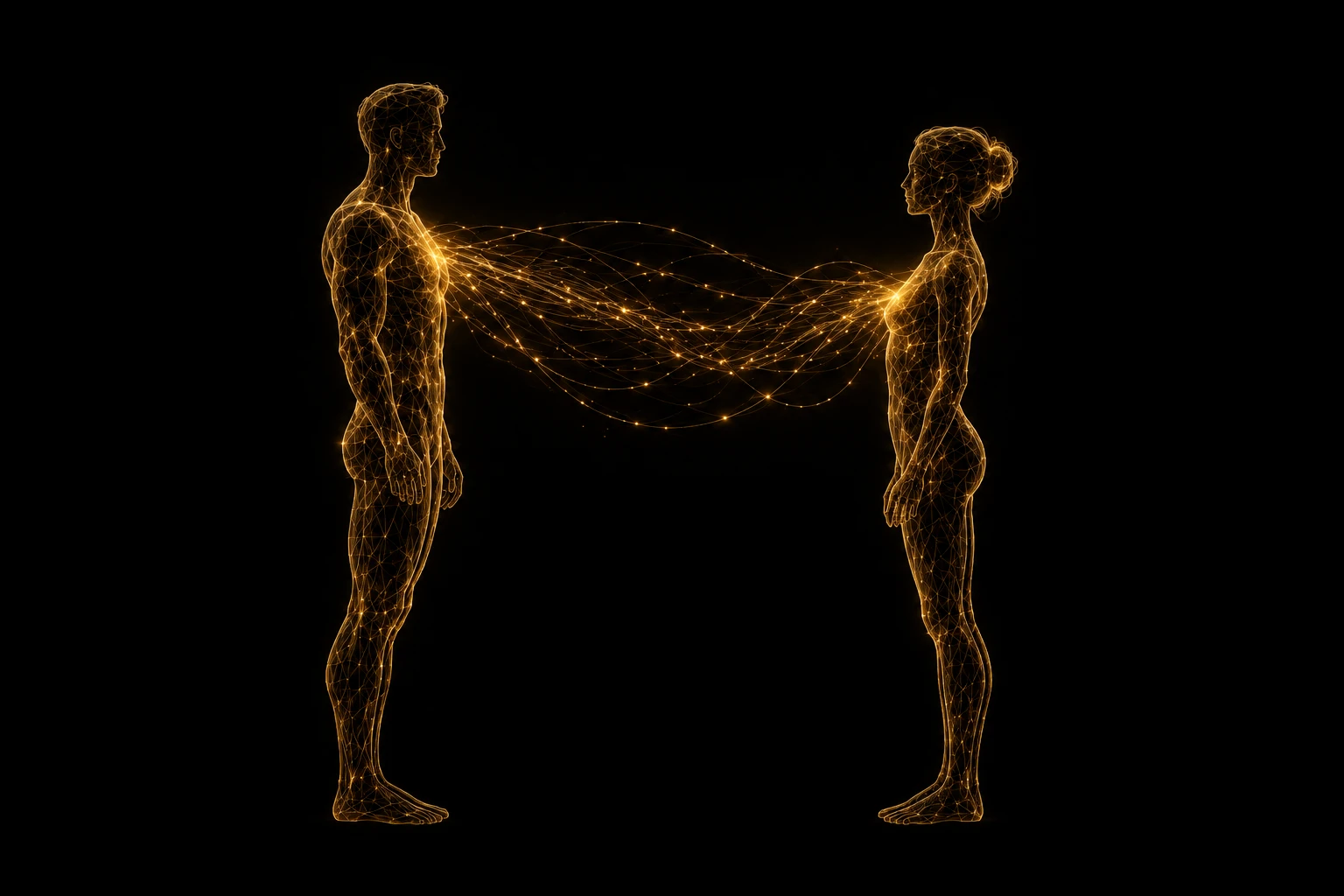
When someone tells you "that's just psychological, don't worry about it," they're probably thinking of your mind as something separate from your body. But there's an even more overlooked separation, and a more measurable one: the one we draw between you and the people around you.
Your skin isn't as closed a biological border as it seems. The quality of your relationships —who listens to you, who judges you, who holds your gaze when you speak— changes your heart rate variability, your cortisol, your inflammatory markers, and even how your brain processes physical pain. That's not a poetic way of putting it. It's measurable physiology, in blood and on a scan.
This is NEXUS's third pillar: Social Relationships. And just like with Movement → and Mind →, we're not going to approach it from self-help, but from what actually happens to your body when you are —or aren't— well accompanied.
Why do social relationships affect your physical health? Because your autonomic nervous system doesn't assess danger in isolation: it uses the presence of other people as one of its most reliable signals of safety, a subconscious evaluation that happens before you can consciously think about it. When you're surrounded by trusted bonds, your body lowers cortisol, improves your heart rate variability (HRV), and reduces low-grade inflammation. When the social environment is ambiguous, hostile, or unpredictable, the opposite happens: your nervous system stays on low but constant alert, accumulating what science calls allostatic load, a real physiological wear, not a subjective feeling. In short: relationships don't just "make you feel good or bad" —they reconfigure your biology.
Your biological wifi: what co-regulation is
Picture your nervous system as a device that needs a connection to work well. When you're with someone you trust, you connect to a clean network: stable signal, no interference, your nervous system shifts into parasympathetic mode without you doing anything special. When you're with someone who generates ambiguity, judgment, or tension, the connection switches to a saturated network: there are drops, there's lag, and you drain battery just by being there, even if from the outside it looks like "nothing is happening."
This has a scientific name: co-regulation. Your nervous system doesn't calibrate its alert level entirely on its own: it borrows part of that capacity from the trusted people around you. It's not emotional dependency; it's exactly the same kind of external regulation we already saw with the vagus nerve and the gut-brain axis →: your body rarely self-regulates in total isolation.
The most compelling demonstration of this is a now-classic experiment in social neuroscience. In 2006, researchers Coan, Schaefer, and Davidson placed 16 married women in a functional MRI scanner and warned them they would receive, at unpredictable moments, a mild electric shock to the ankle. Under that threat, they measured their brain activity across three conditions: holding no hand, holding a stranger's hand, and holding their husband's hand.
When holding their partner's hand, the brain regions associated with the threat response activated considerably less than in the other two conditions. And the higher the perceived quality of that relationship, the lower the threat activation in areas like the right anterior insula, the superior frontal gyrus, and the hypothalamus. Holding a stranger's hand also dampened the response, but far more modestly. The sample was small and specific —married couples— but the mechanism it reveals isn't: your brain literally shares part of the processing of a threat with the trusted person next to you.[1]
You don't calm down "despite" who's with you. You calm down, in a literal and measurable sense, because your brain reduces threat processing when the hand you're holding belongs to someone safe.
The safety scanner: how your nervous system decides whether the environment is refuge or threat
Before you can consciously think "this person makes me feel good" or "something about this environment feels off," your nervous system has already decided for you. Brain structures like the amygdala automatically and subconsciously scan safety or threat cues in the environment —tone of voice, facial expression, speech pace, predictability of others' behavior— before the conscious part of your brain finds out.
The important part: this mechanism can become miscalibrated. Just like we explained when discussing kinesiophobia →, a nervous system that has spent a long time in ambiguous or hostile environments can start reading neutral signals as threatening: a silence, an unanswered message, a normal tone of voice. It's not "being distrustful." It's a social alarm system calibrated by experience, exactly like the pain alarm system we already explained in what is pain? →
Healthy circle vs. reactive circle: the same life, two different physiologies
This isn't about permanently dividing people into "good relationships" and "bad relationships": the same person can live in co-regulation with a friend and in reactive activation with a coworker, on the very same day. But it's worth understanding what happens to your body at each end of that spectrum:
A 2015 meta-analysis published in Biological Psychology, which combined dozens of studies on social interactions and HRV, found something revealing: positive social interactions raise HRV progressively, but negative interactions lower it much faster and more sharply, comparable to the effect of a laboratory stress test. In other words: your body is more sensitive to threat cues than to safety cues, one more reason not to dismiss "that relationship that leaves you drained without knowing why."
Allostatic load: the biological cost of draining relationships
In 1993, researchers Bruce McEwen and Eliot Stellar coined a term that describes exactly this: allostatic load, the cumulative wear your body suffers when the stress-response system —led by the hypothalamic-pituitary-adrenal (HPA) axis and cortisol— gets activated over and over, without enough recovery between activations. It doesn't take an acute trauma. Living sustainedly in a low-grade tension environment is enough.[3]
There's an even more direct proof at the cellular level. Researcher Steve Cole, along with his team, found that people living in chronic loneliness or social isolation show a specific gene expression pattern in their immune cells, which they called the Conserved Transcriptional Response to Adversity (CTRA): pro-inflammatory genes —like IL-6 and TNF— get switched on, while genes that defend against viral infections get switched off. The body literally prepares for a physical threat that never arrives, at the cost of lowering its guard against others.[4]
This wear isn't only genetic or biochemical: it translates directly into how your body repairs tissue. In an experiment with 42 married couples, skin wounds healed noticeably slower after a conflict conversation than after a supportive one.[5] The same pattern shows up in real rehabilitation: in older adults recovering from hip fracture surgery, perceived social support predicted significantly greater functional gains during their inpatient stay, independent of other clinical factors.[6] Who accompanies you during a recovery isn't an emotional detail separate from treatment: it's one more physiological variable.
Unwanted loneliness isn't just a mood. It's a measurable biochemical instruction that reconfigures the expression of your own genes.
Is your social environment a passing bump or a pattern worth attention?
Some signs that the weight of your social environment is no longer just occasional:
- Repeated physical exhaustion. You feel deep fatigue after encounters with specific people, recurrently and not as an isolated case.
- Disrupted rest. You sleep worse or wake up more tired during periods of relational tension, with no change in your sleep habits.
- Amplified physical symptoms. You notice more muscle pain, digestive discomfort, or headaches during periods of conflict or social isolation.
- Avoidance of social contact. You actively avoid contact, even contact you'd normally enjoy, due to accumulated hypervigilance.
This is no small finding: a meta-analysis led by Dr. Julianne Holt-Lunstad, with more than 300,000 participants, found that the premature mortality risk associated with a life with few quality social relationships is of the same order as that of severe obesity.[7] The researcher herself has since summarized that magnitude more intuitively: she compares it, in her own words, to smoking up to 15 cigarettes a day. This isn't a figure of speech: it's a real, independently measurable risk factor.
Where to start: four practical anchors
- Protect one in-person conversation a day. As we already explained in Mind →, face-to-face interaction directly activates the parasympathetic nervous system through eye contact and facial micro-expression. It requires no planning or financial cost.
- Identify, without judging yourself, your own "reactive circle." This isn't about cutting ties abruptly, but about no longer interpreting the exhaustion a specific relationship causes you as a character flaw of your own: it's a coherent physiological response to a real or perceived threat signal.
- Prioritize repair over avoidance in the relationships that do matter to you. Unresolved conflict wears you down more, over time, than conflict that gets addressed and closed: avoiding the uncomfortable conversation doesn't eliminate the allostatic load, it just extends it.
- Combine movement with shared presence. Walking with someone you trust activates both the Movement → pillar and social co-regulation: two physiological regulations for the price of one activity.
Conclusion: borrowed biology
Your nervous system has never lived entirely alone within your skin. It lives, in part, on loan from the people you trust.
You're not you, in isolation, against the world's stress. You are you, regulated or dysregulated, by those around you.
Want to see how this applies to you?
Put these three pillars to the test with the 2-minute educational simulator: body, mind, and environment, applied to your specific situation.
Try the simulator →Frequently asked questions about relationships and the nervous system
Is it literal that other people regulate my nervous system, or is that a figure of speech?
It's literal, with direct evidence in neuroimaging: the study by Coan, Schaefer, and Davidson (2006) showed that holding a trusted partner's hand measurably reduces threat-related brain activation during a stressful stimulus, an effect that doesn't occur —or is much smaller— alone or with a stranger.
Can a tense but non-traumatic relationship affect my physical health long-term?
Yes. It doesn't take a severe conflict or a single crisis episode: sustained exposure to low-grade relational tension repeatedly activates the HPA axis and cortisol release, generating allostatic load, a cumulative physiological wear, measurable in markers like inflammation or heart rate variability (HRV).
Is loneliness really as bad for your health as smoking?
In terms of premature mortality risk magnitude, yes it's comparable, according to Holt-Lunstad's meta-analysis with more than 300,000 participants. The researcher herself has since summarized that magnitude more intuitively: she compares it, in her own words, to smoking up to 15 cigarettes a day.
Why are some people better off alone? Is being alone always harmful?
No. What predicts physiological wear isn't being physically alone, but perceived loneliness: the subjective gap between the connection you want and the connection you feel you have. Research by Cacioppo and Hawkley shows that perceived isolation predicts worse health outcomes more strongly than objective isolation[8] —the actual number of people around you matters less than whether that solitude is experienced as a lack or as a choice. Sought-out solitude, without that underlying signal of threat or lack, doesn't trigger the same threat-detection pattern or the inflammatory response (CTRA) that unwanted isolation does. It's not a matter of character or of being "more or less sociable": your body reacts to how you interpret your social situation, not to how many people are physically in the room.
Do I need a partner to benefit from co-regulation?
No. The reference study used married couples, but the neurobiological mechanism it demonstrates —automatic detection of safety in the presence of someone trusted— isn't exclusive to romantic bonds. Close friendships, family, or any sustained relationship of trust activate the same kind of parasympathetic regulation.
Does this mean I should cut off every difficult relationship immediately?
Not necessarily. The reactive circle isn't a definitive verdict on a relationship: often the tension responds to a repairable communication pattern. Cutting ties by default can avoid short-term wear, but it can also deprive you of bonds that, if worked on, would provide real co-regulation.
How does this relate to the physical pain we've already covered in other articles?
It's the same alarm system we described in what is pain? →, now also calibrated by the social environment and not only by tissue damage. A nervous system that perceives its social environment as unsafe amplifies pain sensitivity; one that feels accompanied and safe reduces it.
Does this replace couples, family, or psychological therapy?
No. This article explains the neurobiology of co-regulation for educational purposes, but it doesn't replace couples, family, or psychological therapy. If a relationship is wearing you down in a way you can't manage on your own, a registered mental health professional can help you address it.
Social Relationships is the third of the six pillars that hold NEXUS up. In the Journal you can already explore our guides on why movement is health →, why the mind affects the body →, what pain is →, and kinesiophobia →.
Cited sources
- [1]Coan JA, Schaefer HS, Davidson RJ. Lending a hand: social regulation of the neural response to threat. Psychological Science. 2006;17(12):1032-1039.
- [2]Shahrestani S, Stewart E, Quintana DS, Hickie I, Guastella AJ. Heart Rate Variability during Adolescent and Adult Social Interactions: A Meta-Analysis. Biological Psychology. 2015;105:43-50.
- [3]McEwen BS, Stellar E. Stress and the individual: mechanisms leading to disease. Archives of Internal Medicine. 1993;153(18):2093-2101.
- [4]Cole SW, Hawkley LC, Arevalo JM, Cacioppo JT. Loneliness, eudaimonia, and the human conserved transcriptional response to adversity. Psychoneuroendocrinology. 2015;62:11-17.
- [5]Kiecolt-Glaser JK, Loving TJ, Stowell JR, Malarkey WB, Lemeshow S, Dickinson SL, Glaser R. Hostile marital interactions, proinflammatory cytokine production, and wound healing. Archives of General Psychiatry. 2005;62(12):1377-1384.
- [6]Zhu Y, Xu BY, Low SG, Low LL. Association of social support with rehabilitation outcome among older adults with hip fracture surgery. Journal of the American Medical Directors Association. 2023;24(10):1490-1496.
- [7]Holt-Lunstad J, Smith TB, Layton JB. Social relationships and mortality risk: a meta-analytic review. PLOS Medicine. 2010;7(7):e1000316.
- [8]Cacioppo JT, Hawkley LC. Perceived social isolation and cognition. Trends in Cognitive Sciences. 2009;13(10):447-454.
Did you like this article?